

The Blue Collar Alternative
College is one path to success – but it’s not the only path. For today’s high school students, there’s a powerful alternative route that’s often overlooked: pursuing a blue-collar career in the skilled trades. Choosing not to attend a traditional four-year college can feel unconventional, especially amid the college-prep pressure many of us face. But for many young people, jumping into a skilled trade after high school can lead to financial stability, job security, personal satisfaction, and plenty of growth opportunities – all without the hefty student loans.
This article explores why a blue-collar career path is worth considering. We’ll highlight the advantages of learning a trade – from avoiding debt to stepping into a booming job market – and bust some myths along the way. Whether you’re a student weighing your options or a parent helping your teen decide, here’s what you need to know about the blue-collar alternative.
The Rising Cost of College (and How Trades Avoid It)
One of the biggest reasons students might shy away from college is the cost. College tuition in the U.S. has skyrocketed in recent decades. A four-year degree often carries a price tag in the tens of thousands of dollars. It’s no surprise that the average new graduate owes over $37,000 in student loans.
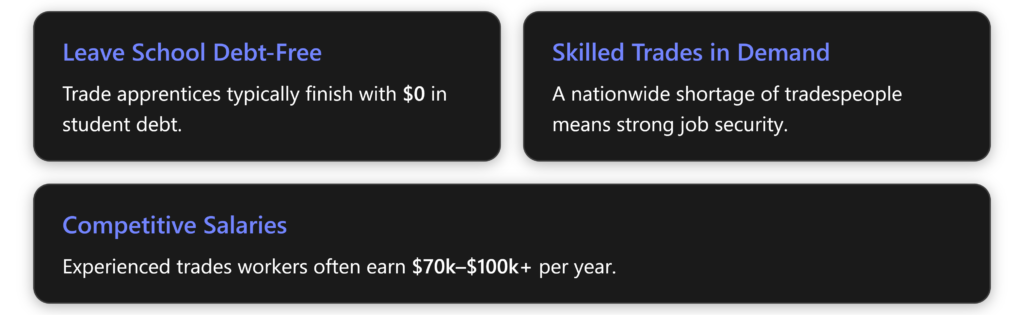
By contrast, blue-collar career paths typically come with little to no educational debt. Many skilled trades are learned through vocational programs or paid apprenticeships that cost a fraction of a university degree – or even pay you while you train. For example, instead of paying tuition for four years, an apprentice electrician or plumber usually earns a starting wage (around $35,000–$45,000 per year) while learning on the job. By the time your college-bound peers are graduating (often with debt), you could be debt-free, with four years of real-work experience and earnings under your belt.
Avoiding college loans can truly jump-start your financial life. Without that burden, you can start saving and investing earlier. Many tradespeople reach a positive net worth in their early twenties, whereas college graduates might spend those early years just catching up financially.
Strong Job Demand and Stability
Another big advantage of blue-collar careers is that the job market is hungry for skilled tradespeople. Many industries – construction, electrical work, plumbing, automotive repair, manufacturing, and more – face a shortage of workers as older tradespeople retire. As baby boomers leave these professions, there aren’t enough new workers to replace them. The result is high demand for blue-collar skills and lots of job openings.
This labor gap isn’t a short-term blip, either. It’s projected to continue through 2030 and beyond. For young people entering these fields now, that demand means excellent job security. Employers need electricians, mechanics, welders, and technicians in every city – and you can’t outsource a broken air conditioner or a construction project overseas. These jobs also tend to be resilient to automation – you can’t fix a leaky pipe with a robot, after all. Skilled trades offer steady, reliable work that’s here to stay.
By comparison, a college degree isn’t a guarantee of a job – far from it. Many college grads find the job market crowded and competitive. In fact, roughly 4 in 10 recent college graduates end up underemployed, working in jobs that don’t require a four-year degree. Not going to college can lead to a more secure job situation if you enter a high-demand trade.
On the flip side, if you train as a welder, HVAC technician, electrician, or another hands-on professional, you’ve got a skill set that’s in clear demand. Every community needs its roads paved, its homes maintained, its cars repaired, and its power grid running. These careers are the backbone of the economy – and that stability means your skills will always be needed. Not going to college can, in many cases, be a very safe choice if you enter a high-demand trade.
Earning Potential: More Than You Might Think
There’s a common misconception that blue-collar jobs don’t pay well. In reality, many skilled trades offer incomes that rival – or even exceed – those of jobs requiring a college degree. Yes, some entry-level trade jobs start at modest wages, but they often rise quickly as you gain experience. And remember, you’re earning from day one – whereas a college student typically won’t start earning a full-time salary until their early twenties.
Consider this: A first-year apprentice might make around $30,000–$40,000 a year. But after a few years, once you become a fully qualified journeyman, your earnings jump significantly. Skilled trade workers across industries earn a median salary of around $75,000 per year in the U.S.. It’s not unusual for experienced tradespeople – like master electricians, plumbers, or heavy equipment operators – to make $80,000, $90,000, or even six-figure incomes, with no college degree required.
How does that compare to college grads? Certain majors (like engineering or computer science) do lead to high salaries, but on average the comparison might surprise you. The average salary for a college graduate is around $45,000 a year, and many start out lower if they don’t have an in-demand degree. Meanwhile, a young tradesperson can often reach or surpass that income by their mid-twenties – without the burden of student debt, and with several years of earnings already banked.
Additionally, many trades offer overtime pay or side gigs that can boost your income – a perk many office jobs don’t provide. Plus, wages in many trades are rising as employers compete for talent in short supply.
Career Growth and Personal Fulfillment
Beyond the immediate pay and job openings, the blue-collar path offers substantial room for career growth and personal fulfillment. In trades careers, there’s usually a clear progression: you might start as an apprentice or helper, move up to a journeyman (fully proficient in your trade), and in many fields you can become a master or licensed expert. With experience, you could advance to supervisory roles like foreman or project manager. Ultimately, many tradespeople even go on to start their own businesses – it’s common for an experienced plumber, electrician, or contractor to become an independent business owner providing services in their community. That entrepreneurial route means a blue-collar career can be a pathway to being your own boss one day.
Another often overlooked advantage is job satisfaction. Not everyone wants a desk job. If you love working with your hands, being active, and seeing the tangible results of your work, a trade can be far more fulfilling than sitting in an office. There’s a special pride in building a house, repairing a car, or keeping critical systems running. You can see the difference you make each day. Many tradespeople enjoy their work because it’s engaging, varied, and meaningful – you’re solving real-world problems and people rely on your skills. By contrast, someone who prefers hands-on work might feel restless or underutilized behind a desk. The bottom line is that career satisfaction comes from finding work that fits your interests and strengths – and for a lot of folks, that means working outside the cubicle.
Comparing Blue-Collar vs. College Paths: Key Advantages
We’ve covered a lot of ground. Here’s a quick summary of how the blue-collar path stacks up against the traditional college route on some key points:
| Factor | Skilled Trades (Blue-Collar Path) | Traditional College Path |
|---|---|---|
| Education Cost | Low cost (trade school often <$10k; many apprenticeships are paid) → little or no debt | High cost (4-year college often $40k–$100k+) → student loan debt common |
| Time to Start Career | Short training (6 months – 2 years); start earning immediately. | Long education (4+ years); no full-time earnings until after graduation. |
| Early Career Earnings | Earn while you learn (~$30k–$40k as an apprentice) income rises with experience. | No earnings during college; entry-level salary after graduation (~$45k on average) |
| Mid-Career Earnings | Many trades ~$70k–$100k+ after a decade of experience | Varies by field – some careers pay well, others less (often requires grad school for higher pay). |
| Job Market Demand | Very high – nationwide skilled labor shortage; strong job security | Mixed – some majors in demand, others face oversupply; many grads underemployed |
| Advancement Path | Clear steps: Apprentice → Journeyman → Master; can become a contractor/owner | Varies: Entry-level → promotions; may require higher degrees for advancement. |
| Work Environment | Active, hands-on, often outdoors or on-site; new challenges daily. | Typically indoors/office-based; work can be more desk-oriented. |
| Job Satisfaction | High for those who enjoy physical, practical work; tangible results. | High for those who enjoy academic or professional settings; intangible outcomes. |
Conclusion: Choosing Your Own Path
Ultimately, the decision of whether to go to college or pursue a trade comes down to your own interests, goals, and learning style. The key is to make a conscious, informed choice – not simply follow one path because “that’s what everyone does.” College is ideal for certain careers and personalities and can be very rewarding for students who thrive in academic settings or need a degree for their chosen profession. But skilled trades are just as valid and can be even more rewarding for those who prefer a more hands-on, independent approach.
If you’re a student, take time to explore both options (talk to a school counselor, try a shop class or shadow someone in a trade). And if you’re a parent, remember there are multiple paths to success – the best one is the option that fits your child’s goals and interests.
Choosing a blue-collar career is not “settling” – it’s an active decision to pursue success on your own terms. It can lead to a stable, well-paying career without the mountain of debt. For many young adults, it’s also a path to confidence and independence, as you master real-world skills and start contributing to your community right away. As you plan your future, remember: college is one path, but the trades are another. Whichever route you choose, make sure it’s an informed decision that sets you up to thrive.