Igniting a Career in Welding
Choosing a career in welding can spark a bright future. Welding isn’t just about fusing metal – it’s about building bridges (literally and figuratively) to stable, well-paying jobs. This blog-style guide walks you through how to get started in welding, how to advance, what you can earn, and the different paths this field offers. Written in a casual, engaging tone for middle and high school students (and their parents) in the U.S., let’s strike the arc on a welding career!
Getting Started: High School and Beyond 🚀
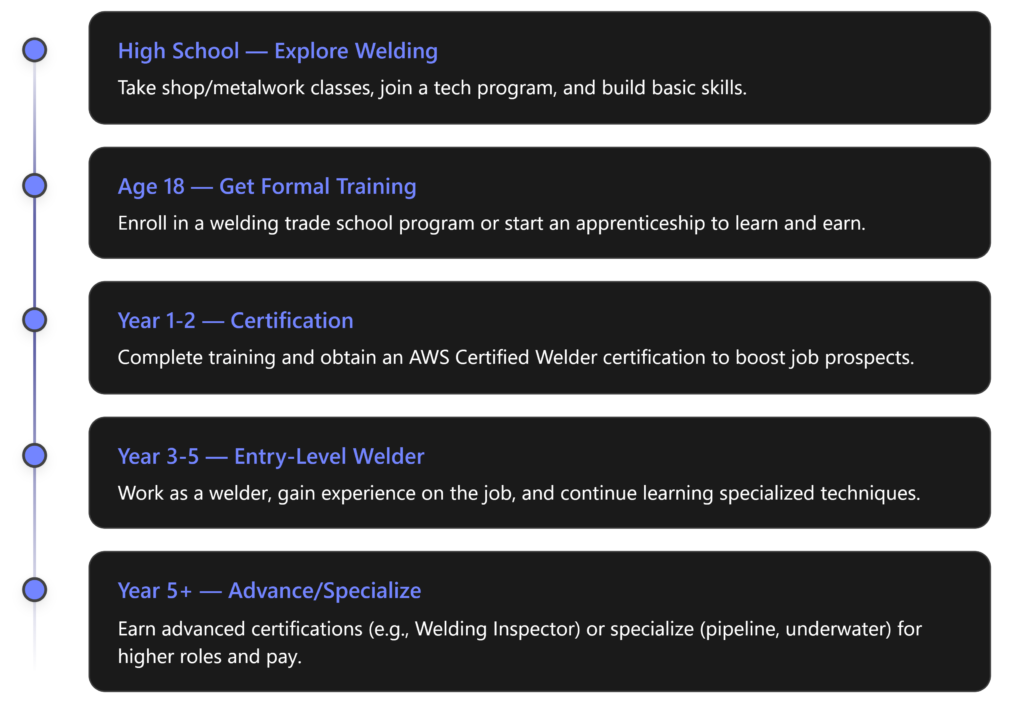
High School Preparation: If you’re in high school, start now! Take any available shop classes or welding courses. Many high schools and career-tech centers offer introductory welding or metalworking classes. These classes teach basics like safety, how to use welding equipment, and simple welding techniques. Even if your school doesn’t have welding, focus on math and science – algebra, geometry, and physics – because welders often read blueprints and need to understand measurements and materials. Bonus: Participating in a robotics club or makerspace that involves metalwork can also give you hands-on experience.
Explore Vocational Programs: Look into high school vocational programs or dual-enrollment with a local community college. Some U.S. schools partner with technical colleges so students can start learning trades (like welding) in 11th or 12th grade. This can give you a head start and even earn you a welding certification by graduation.
Entry-Level Opportunities: Right out of high school, you have a few options:
- Trade School or Community College: Enroll in a welding program at a technical school or community college. These programs often last 6-18 months (or ~2 years for an associate degree) and teach various welding methods (MIG, TIG, stick, etc.). You’ll practice in a workshop and often end with an AWS (American Welding Society) certification exam. Graduating from a welding program makes you job-ready as an entry-level welder.
- Apprenticeship: An apprenticeship is a “learn-and-earn” pathway. As an apprentice welder, you’ll work for a company or union shop under experienced welders and get paid while you train. Apprenticeships typically last 2-4 years. For example, unions like the Ironworkers or Pipefitters often offer welding apprenticeships. You start with basics and gradually take on more complex tasks as your skills grow (and your pay increases). By the end, you’ll be considered a journey-level welder with a nationally recognized completion certificate.
- On-the-Job Training: In some cases, employers hire folks with little experience as welder helpers or trainees. You might start by doing simple tasks (like preparing materials or grinding welds) and learn welding skills from mentors at work. This path might be slower without formal schooling, but it works for some – especially if you show enthusiasm and a willingness to learn.
Climbing the Ladder: Training, Certifications, and Advancement 📈
Starting out is just the first step. Welding is a skill-based profession, so advancing means continuously improving your craft and often earning certifications. Here’s how you progress:
- Certifications Matter: The main certification for new welders is AWS Certified Welder. The AWS (American Welding Society) certification involves hands-on welding tests to prove you can make sound welds under certain codes/standards. You can test in various processes (like TIG or MIG) and on different materials. Having this cert shows employers you meet industry standards. As you advance, other certs include Certified Welding Inspector (CWI) – usually pursued after ~5+ years of experience – which allows you to inspect and quality-check other welders’ work (often a higher-paying, more supervisory role). There are also certifications for specific skills, like underwater welding certification (which requires commercial diving training) or specialized procedures used in pipelines or aerospace.
- Apprenticeships & Journeyman Status: If you go the apprenticeship route, each year of your apprenticeship you’ll hit milestones (and pay raises). By the end, you become a journey-level welder (fully qualified). With journeyman status (or a few years of experience from any path), you can take on more responsibility, work on more complex projects, or even move jobs easily since your skills are proven.
- On-the-Job Learning: Welding technology keeps evolving – from new welding machines to new techniques (like laser welding or robotics programming). Good welders keep learning. Many employers offer training workshops, and you can also take specialized courses (e.g., pipe welding, exotic metals welding) through unions, trade associations, or community colleges even after you’ve started working.
- Advancing Your Career: After you’ve spent some years striking arcs, you might move up to roles like Senior Welder, Welding Foreman/Supervisor (leading a team of welders on a job site or in a shop), or become a specialist. Some experienced welders branch into welding inspection, teaching, or even welding engineering (with additional schooling). The more advanced your skills and certifications, typically the higher your earning potential and job options.
Show Me the Money: Welding Salaries at Each Stage 💰
One big question: How much do welders make? Welding can offer a solid middle-class income, and with specialization, some welders earn very high wages. Earnings vary by region, industry, and your experience level. Here’s a look at potential earnings as of mid-2020s in the U.S.:
| Career Stage | Experience Level | Typical Earnings (Annual) |
| Entry-Level Welder | 0–2 years, basic certification | ~$30,000 – $40,000 (around $15–$20/hour) |
| Mid-Level Welder | 3–5 years, some advanced certs | ~$45,000 – $60,000 (around $22–$28/hour) |
| Experienced/Senior Welder | 10+ years or specialized skills | ~$60,000 – $80,000 (often $30+/hour) |
| Specialized Welder (High) | Special skills (e.g. underwater, pipeline) | $100,000+ (elite experts can earn six figures) |
A closer look: According to the U.S. Bureau of Labor Statistics, the median annual wage for welders (cutters, solderers, and brazers) is around $47,000 per year. Entry-level positions may start near $30k, but as you gain experience or certifications, your pay rises. Many mid-level welders earn in the $50k range. If you become highly skilled or take on tough, high-demand jobs, the pay can jump even more. For example, pipeline welders who travel for oil & gas projects or underwater welders (who repair ships or underwater structures) often earn $80k-$100k+, because the work is challenging (and sometimes risky). Additionally, a Certified Welding Inspector, who ensures quality standards, can also earn upwards of $60k-$70k or more with experience.
Keep in mind, overtime can boost earnings significantly. Welders in construction or industrial jobs might work overtime during big projects, meaning extra pay. Some union welders have set pay scales with periodic raises. Geography matters too – welding jobs in high-cost areas or in booming industrial regions (e.g., Gulf Coast oil industry or Midwest manufacturing) might pay more than those in other places.
Different Paths Within the Welding Field 🔀
Welding isn’t one-size-fits-all. There are many career paths within welding, and you can choose one that fits your interests and lifestyle. Here are a few exciting welding avenues:
- Manufacturing/Industrial Welder: These welders work in factories or plants building things like cars, airplanes, appliances, or heavy machinery. One day you might be welding car frames; another day, assembling agricultural tractors. Often, this involves repetitive welding tasks, sometimes using robotics. It’s usually indoor work, stable hours, and you become an expert in a specific production process.
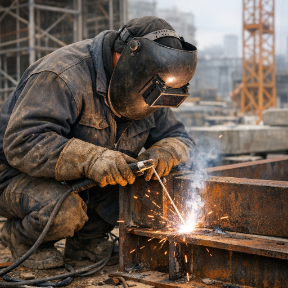
- Construction/Structural Welder: If you’ve seen photos of workers welding steel beams on skyscrapers – that’s this path. Structural welders join steel for buildings, bridges, and infrastructure. You might work for construction companies, building everything from high-rise frames to giant sports stadiums. It can mean working at heights (on scaffolding) and outdoors. It’s a thrilling job if you like working with big structures.
- Pipeline Welder: Pipeline welders specialize in joining pipes that transport oil, natural gas, or water. This often means traveling to wherever a pipeline is being built – could be a remote field, desert, or even Alaska. Pipeline welding requires precision (pipe joints often get X-rayed to check quality) and often uses stick or TIG welding. These jobs can pay very well, since they’re often unionized and critical for energy infrastructure.
- Underwater Welder: For the adventurous, underwater welding combines diving with welding. These specialists (often commercial divers) repair and construct underwater structures – think oil rigs, ship hulls, underwater pipelines. It’s one of the most dangerous and highly paid welding jobs. Underwater welders must undergo rigorous dive training and welding training. While entry into this field is tough, experienced pros can earn six figures due to the level of skill and risk involved.
- Welding Inspector or Instructor: After years of experience, some welders transition to Certified Welding Inspectors (CWIs) who examine welds for quality and safety, or to instructors who teach the next generation of welders at schools or union training centers. Inspectors use tools and tests (like ultrasound or X-ray) to ensure critical welds (like on a bridge or pressure vessel) are defect-free. These roles often come later in a welding career and can be less physically demanding while leveraging your expertise. They also pay well and are in demand, since companies and schools need seasoned experts.
- Artistic and Custom Welding: Not all welding careers are industrial. Some welders use their skills for art and custom fabrication. They might craft metal sculptures, custom furniture, or decorative ironwork. This path might require an entrepreneurial spirit – possibly starting your own small business or freelance services. While it’s a different kind of career, it shows how versatile welding skills can be!
No matter which path you choose, welding skills are highly transferable. Some welders even hop between paths – e.g., a structural welder might do pipeline jobs seasonally, or a manufacturing welder might take side gigs building custom motorcycle frames.
Wrapping Up: Welding Your Future Together 🛠️
Welding offers a mix of hands-on work, creativity, and solid earnings that’s attractive for students who prefer active careers over desk jobs. For high schoolers and parents considering this path, remember these key takeaways:
- Start Early: Take advantage of high school vocational programs or community college classes to build a foundation.
- Training Pays Off: Whether through a trade school or an apprenticeship, formal training and certifications (like those from AWS) will jump-start your welding career.
- Career Growth: Welding isn’t dead-end – you can climb from newbie to expert, increase your earnings, and even pivot to specialized or leadership roles.
- Financial Upside: Avoid big college debt, earn while you learn in apprenticeships, and step into jobs that can pay very well as you gain experience.
- Many Paths: From building massive skyscrapers, traveling for pipeline projects, diving underwater, to crafting art — welding can take you in many exciting directions.
Lastly, welding is in high demand across the U.S. as older tradespeople retire and industries grow. Skilled welders are needed to build and fix the world around us – and that could be you. So if the idea of cutting, fusing, and creating with metal sparks your interest, go ahead and strike while the iron is hot – a rewarding welding career could be waiting for you!
