
GEORGIA
Tuition-Free Vocational Schools in Georgia (Major Cities)
Georgia offers tuition-free vocational training through its public technical colleges and state-funded programs. These institutions provide career-focused education in fields like healthcare, information technology, skilled trades, and more, with tuition fully covered for eligible students. Below is a detailed overview of major tuition-free vocational schools in Georgia’s key cities, including program offerings, eligibility for free tuition, and contact information. All information is based on official Technical College System of Georgia (TCSG) sources and state education data for maximum accuracy.
Major Tuition-Free Vocational Schools in Georgia
The table below highlights tuition-free technical colleges in Georgia’s major metropolitan areas, along with example programs, eligibility for free tuition, and official contact details (phone and email):
| School (Location) | Example Programs Offered | Free Tuition Eligibility Highlights | Contact Info (Phone / Email / Website) |
| Atlanta Technical College (Atlanta) | Healthcare (e.g. Practical Nursing), Information Technology, Automotive Technology, Construction Trades | • High school students attend free via Dual Enrollment. • Adults: HOPE Career Grant covers tuition for high-demand programs. WIOA available for eligible adults. | 📞 (404) 225-4400 ✉️ admissions@atlantatech.edu 🌐 https://www.atlantatech.edu |
| Augusta Technical College (Augusta) | Welding & Manufacturing, Cybersecurity, Nurse Aide (CNA), Automotive Repair | • High schoolers attend free via Dual Enrollment. • Adults: HOPE Grant + HOPE Career Grant cover tuition for high-demand fields. | 📞 (706) 771-4000 ✉️ admissions@augustatech.edu 🌐 https://www.augustatech.edu |
| Savannah Technical College (Savannah) | Culinary Arts, Aircraft Structural Technology, Practical Nursing, Electrician & HVAC | • High school Dual Enrollment covers tuition and fees. • Adults: HOPE Career Grant covers tuition for eligible programs. | 📞 (912) 443-5700 ✉️ admissions@savannahtech.edu 🌐 https://www.savannahtech.edu |
| Central Georgia Technical College (Macon) | Commercial Truck Driving (CDL), Early Childhood Education, Medical Assisting, Industrial Maintenance | • High school students attend free via Dual Enrollment. • Adults: HOPE Career Grant covers tuition for high-demand fields. | 📞 (478) 757-3400 ✉️ info@centralgatech.edu 🌐 https://www.centralgatech.edu |
| Columbus Technical College | Licensed Practical Nursing, Welding, Business Admin Tech, Diesel Equipment Technology | • High school Dual Enrollment covers tuition and books. • Adults: HOPE Grant + HOPE Career Grant cover tuition for high-demand programs. | 📞 (706) 649-1800 ✉️ admissions@columbustech.edu 🌐 https://www.columbustech.edu |
| Job Corps (Georgia Centers) (Atlanta, Brunswick, Albany) | Construction, Healthcare, Hospitality, Information Technology (residential training) | • Federal program for ages 16–24. • Income-eligible youth receive free training, housing, and meals. | 📞 (800) 733-5627 ✉️ GAJobCorps@gov 🌐 https://www.jobcorps.gov |
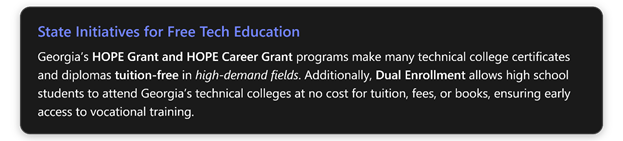
Sources: According to the Georgia Student Finance Commission and TCSG, high school students in Georgia can attend technical colleges tuition-free through the state’s Dual Enrollment program (formerly “Move on When Ready”), which covers tuition, fees, and textbooks. For adult learners, Georgia’s HOPE Grant (for certificate and diploma students) and the HOPE Career Grant provide full tuition coverage in 17+ designated high-demand fields (e.g., practical nursing, commercial trucking, welding, early childhood education, precision manufacturing, etc.). These grants are funded by the state lottery and administered by the Georgia Student Finance Commission, ensuring that many technical college programs have no out-of-pocket tuition costs for Georgia residents. Additionally, Workforce Innovation and Opportunity Act (WIOA) funds are available through Georgia’s Department of Labor and local career centers to cover expenses for eligible job seekers pursuing vocational training.
How Georgia’s Tuition-Free Vocational Training Works
Georgia leverages a combination of state lottery-funded scholarships and federal programs to eliminate tuition for vocational students:
- Dual Enrollment for High School Students: Georgia’s Dual Enrollment program allows 11th and 12th graders (and even eligible 10th graders for certain technical programs) to take courses at technical colleges tuition-free. The state covers tuition, mandatory fees, and provides a book allowance for these students. For example, a high school senior in Atlanta can spend part of the day at Atlanta Technical College training as a nursing assistant or electrician without any cost, earning both high school and college credit.
- HOPE Grant & HOPE Career Grant for Adults: The HOPE Grant covers a significant portion of tuition for Georgia residents enrolled in diploma or certificate programs at TCSG colleges (regardless of high school graduation year or age, unlike the HOPE Scholarship). On top of this, the HOPE Career Grant (formerly Strategic Industries Workforce Development Grant) provides additional funds that cover the remaining tuition for specific high-demand programs. These fields are determined by the state to be critical for Georgia’s economy – including healthcare, information technology, manufacturing, transportation, and construction trades. In practice, this means many adult students pay $0 in tuition for programs like Practical Nursing, Welding, Commercial Truck Driving, Early Childhood Education, Diesel Mechanic, etc., as long as they meet basic HOPE residency and academic progress requirements. Students must be Georgia residents and maintain a minimum GPA (typically 2.0 for HOPE Grant eligibility) in their program.
- Additional Workforce Funding: For programs or students not covered by HOPE grants (for instance, those pursuing training outside the HOPE high-demand list or needing support for books and supplies), other options exist. WIOA funding, administered through entities like WorkSource Georgia, can cover tuition, fees, and material costs for unemployed or underemployed individuals enrolling in approved training programs. Many technical colleges work closely with local career centers to connect students with these opportunities. Moreover, Veterans can often use GI Bill benefits at technical colleges, and the state offers a $500 HOPE GED Grant to students who’ve earned a GED, which can defray educational costs.