TENESSEE
Free Vocational Programs for Tennessee High School Students
Tennessee offers a variety of free programs and resources – run by state agencies, the federal government, and nonprofits – to help high school students explore and start careers in skilled trades. Below is an overview of the most important programs, including who they serve, what they provide, and how to contact them, followed by a detailed breakdown.
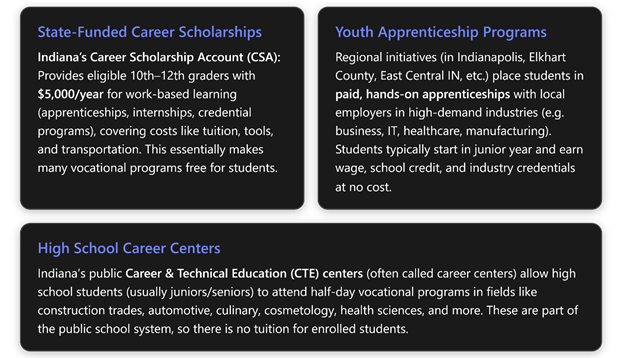
1. Tennessee High School CTE Programs (Grades 9–12) – State-Funded
What it is: Tennessee’s public high schools offer Career & Technical Education (CTE) programs as part of the regular curriculum. Students can take career-oriented classes in 16 nationally recognized “career clusters” covering virtually every trade and technical field. These clusters include Construction, Manufacturing, Health Sciences, IT, Agriculture, Transportation, Hospitality, and more – ensuring that all major skilled trades and career pathways are represented statewide. High school CTE courses often lead to industry certifications, technical skills, and work-based learning opportunities before graduation. [kidcentraltn.com] [kidcentraltn.com], [kidcentraltn.com]
Cost: All high school CTE classes are free for students as part of public education. There are no additional fees to enroll in these courses – they are funded by the state and federal (Perkins V) education funds. [kidcentraltn.com], [kidcentraltn.com]
Eligibility: Any Tennessee high school student (grades 9–12) can enroll in CTE elective classes. Many schools allow students to begin introductory courses in 9th or 10th grade and progress to advanced or dual-credit courses in 11th–12th grade within a chosen pathway. No special application is typically required beyond your school’s course registration.
Services/Training Provided: Students get hands-on training and instruction in their chosen field during the school day. For example, a student might take courses in automotive technology, welding, nursing assisting, coding, or culinary arts, depending on what is offered at their school. Programs often partner with local industries for equipment, curricula, or internships, and many offer the chance to earn certifications or licenses (such as OSHA 10 safety cards, Certified Nursing Assistant credentials, etc.) by graduation. These courses also include career counseling and may involve participation in student organizations like SkillsUSA, FFA, or HOSA to build leadership and competition skills in trades.
After high school: Completing a CTE pathway can give students advanced standing or credit in postsecondary programs. Notably, Tennessee’s CTE is aligned with colleges and apprenticeships, so students are prepared to enter a technical college, apprenticeship, or entry-level job directly. (Additionally, Tennessee’s “Work Ethic Distinction” or similar programs recognize CTE students with strong employability skills, though this is an enhancement rather than a separate program.)
How to get started: Rising 9th graders typically learn about CTE options during high school orientation or from guidance counselors. To enroll, students/parents should speak with the school’s counselor or CTE program coordinator about available programs of study. Each school district may have a brochure of its CTE offerings. The Tennessee Department of Education’s website provides descriptions of each career cluster and CTE pathway. [kidcentraltn.com]
Contact for more info: Tennessee Department of Education, Division of College, Career & Technical Education – Phone: (615) 741-5158; Email: CCTE.Questions@tn.gov. (Or simply contact your local high school’s counseling office for CTE program information.) [tn.gov]
2. Dual Enrollment at Tennessee Colleges of Applied Technology (TCAT) – State-Funded
What it is: Tennessee high school juniors and seniors can take free career-tech courses at Tennessee Colleges of Applied Technology (TCATs) or community colleges for dual credit. TCATs are the state’s technical colleges, offering programs in welding, automotive repair, electrical technology, plumbing, HVAC, nursing, cosmetology, information technology, and many other trades. Through the Dual Enrollment Grant program, high school students enroll part-time at a TCAT while still in high school, earning college credits (or clock hours) that count toward a postsecondary certificate and count toward high school graduation requirements. [collegefortn.org], [collegefortn.org]
Cost: Tuition is fully covered by Tennessee’s Dual Enrollment Grant (funded by the state lottery) for a certain number of courses. The first four dual-enrollment courses are free of charge, and additional courses receive partial funding up to 10 courses total, as long as the student meets the grant criteria. In practice, this means a student can often complete a full TCAT certificate or diploma tuition-free by the time they graduate high school (for example, some students finish a welding certificate during high school). There may be minor costs like tools or books in some programs, but many high school partnerships provide necessary supplies or cover costs through Perkins or other funds (families should verify with the specific TCAT campus). [collegefortn.org]
Eligibility: High school juniors and seniors at public, private, or homeschool are eligible; younger students (9th–10th) can participate at TCATs on a case-by-case basis (the grant explicitly allows TCAT dual enrollment for freshmen and up, though priority is older students). Students must be Tennessee residents and meet the TCAT’s admission requirements (often a simple application and maybe placement tests or prerequisites for certain trades). Maintaining a minimum 2.0 GPA in the college courses is required to continue receiving the grant. Each TCAT may have specific enrollment deadlines (often aligning with college trimester start dates – typically August for fall, January for winter/spring, and a summer term). [collegefortn.org]
Services/Training Provided: Dual enrollment students attend classes at the TCAT campus or online (sometimes a TCAT instructor might even come to the high school). They receive the same hands-on training as adult TCAT students – operating real equipment and learning techniques in their trade. They earn college credit hours or clock hours toward a state-recognized technical diploma. Many programs can lead to industry certifications (for example, OSHA safety certification, NCCER construction credentials, CompTIA IT certifications, etc.) by the end. Some high school students attend TCAT in the mornings or afternoons and spend the rest of the day at their high school, effectively starting a trade school early at no cost. Dual enrollment students are typically treated as regular college students, so they also have access to the TCAT’s career services (job placement assistance) when they finish. [collegefortn.org]
After high school: Students can continue at the TCAT (often needing only a few months post-graduation to complete a full program, since they started early) or use the credits at a community college (for certain programs). Tennessee also offers the Wilder-Naifeh Technical Scholarship for adults, and the Tennessee Promise scholarship, which covers tuition for TCAT or community college after high school – so a student who starts with dual enrollment can seamlessly continue for free or very low cost. Many dual enrollment students receive job offers or apprenticeships immediately after finishing, thanks to the TCAT’s close ties with local employers.
Application Deadlines: Students should apply for the Dual Enrollment Grant by June 30 prior to the semester they want to start (e.g. end of Junior year for Senior year classes). High schools often organize sign-ups in the spring. It’s recommended to start the process by talking to the school counselor in sophomore or junior year to align schedules and complete the necessary online grant application (via the CollegeforTN/TSAC student portal). [collegefortn.org]
How to get started: Discuss interest with your school counselor and visit the nearest TCAT campus to see what high-school programs they offer. Complete the TCAT’s dual-enrollment admission form and the state’s Dual Enrollment Grant application. Each TCAT has a Dual Enrollment Coordinator to assist high school applicants.
Contact for more info: Website: [Tennessee Dual Enrollment Grant – Overview](https://www.collegefortn.org/dualenrollment/) – provides details on the grant and application process. You can also contact your local TCAT campus; for example, TCAT Nashville (615-425-5500, info@tcatnashville.edu) or TCAT Knoxville (865-546-5567, dual enrollment office at de@tcatknoxville.edu). A full list of TCAT campus contacts is available via the Tennessee Board of Regents. [collegefortn.org]
3. Tennessee Youth Employment Program (YEP) – State Workforce Program (WIOA Youth)
What it is: The Youth Employment Program (YEP) is Tennessee’s implementation of the federal Workforce Innovation & Opportunity Act (WIOA) Youth program. It provides free career exploration, job training, and paid work experience opportunities for eligible youth ages 14–24. The focus is on helping students (especially those with barriers or from low-income backgrounds) to build job skills and transition into employment or further education. YEP is a year-round program statewide (often coordinated through local American Job Centers), and includes the state’s summer employment initiative. In short, this program helps high schoolers get internships/apprenticeships, career coaching, and even supportive services at no cost. [tn.gov], [tn.gov]
Cost: Free. This program is funded by the U.S. Department of Labor and administered by the Tennessee Dept. of Labor & Workforce Development. Not only is participation free, participants earn wages or stipends for work experiences – for example, students might earn up to ~$3,500 over a program period through a part-time paid internship. Any training fees (such as a certification class) can be covered by the program if it’s part of the service plan. Support services – such as transportation assistance, uniforms, or exam fees – are also provided free for participants who need them. [yeptn.com] [dol.gov]
Eligibility: Youth must be 14–24 years old. There are two categories: In-School Youth (ISY) – ages 14–21 who are still in school (high school) and meet certain low-income and “barrier” criteria, and Out-of-School Youth (OSY) – ages 16–24 who are not attending school (e.g. dropouts or graduates unemployed/without college). For in-school youth (relevant to 9th–12th graders), generally the student must have a low household income or other barrier (examples of barriers: basic skills deficient, English language learner, in foster care, homeless, has a disability, pregnant/parenting, or needs extra assistance to graduate). The eligibility is assessed via an application at the local American Job Center. Note: Students do not necessarily have to drop out or be failing – many WIOA Youth participants are at-risk students or simply low-income and seeking career help. It prioritizes those who might not have as many resources or who are first-generation future college students, for instance. [tn.gov], [tn.gov] [tn.gov]
Services Provided: This is a comprehensive menu of services tailored to each youth’s needs. Key components include:
- Career Exploration & Guidance: One-on-one counseling to identify career interests. Job shadowing and company tours to explore different trades or industries are often arranged. [secareercenter.org]
- Educational Support: Tutoring, study skills workshops, and assistance to ensure the student completes high school. They might also pay for prep classes for certifications or dual enrollment courses not covered elsewhere.
- Work Readiness Training: Workshops on resume writing, interview skills, professionalism, and financial literacy. [secareercenter.org], [secareercenter.org]
- Paid and Unpaid Work Experience: This is a major part. YEP can place students in summer jobs, internships, or job shadowing roles with local employers in fields like construction, healthcare, manufacturing, IT, etc., usually for several weeks. These can take place during summer or after school, and participants are paid wages by the program (the employer gets free intern labor, the student gets experience + paycheck). There are also pre-apprenticeship programs funded through YEP, meaning a student might spend part of the time training at a site (like learning construction basics) which can lead into a registered apprenticeship. [tn.gov]
- Occupational Skills Training: If a youth needs specific training (say a CNA nursing aide course, or a welding certification class) that is not otherwise free, the program can sponsor the youth to attend a technical course or night class with tuition paid by WIOA. They also partner with TCATs and community colleges for short-term training programs.
- Mentoring and Leadership Development: Activities such as community service projects, leadership clinics, or mentorship match-ups are provided (for example, pairing the student with a mentor from an industry).
- Support Services: Transportation (bus passes or gas cards), childcare (for parenting teens), work clothes or tools, and even referral to health care or housing if needed – all to remove barriers so the youth can succeed. [dol.gov]
Application Deadlines: YEP/WIOA Youth operates year-round; one can apply at any time. Summer employment opportunities often ramp up in late spring (with many programs starting in June), so students are encouraged to apply by late spring for summer slots. The statewide summer YEP 2025 program ran from July 1, 2025 – June 30, 2026 (a program year), indicating rolling enrollment. Essentially, there is no firm deadline – reach out as early as possible. If a local area has a limited number of internship slots, they may have priority enrollment periods. [tn.gov]
How to get started: To join, a student (with a parent/guardian if under 18) should contact their local American Job Center (AJC) or youth program provider. Every county is served by an AJC; guidance counselors often have contact info for the nearest center. The American Job Center will schedule an orientation or intake meeting to determine eligibility. There is usually an application form and some documentation needed (proof of age, income, etc.). Once enrolled, a career specialist will develop an individualized plan with the student.
Contact for more info: The Tennessee Dept. of Labor has a Youth Program contact email: TN.Youth@tn.gov. You can email them with your city/county and they will direct you to the local youth coordinator. Phone: You may also call or visit a local American Job Center; find locations via the TN AJC Locator. For example, in Memphis, the AJC youth line is 901-707-8426; in Nashville/Middle TN, (615) 253-8920 is a general Workforce Development line. Website: The state’s YEP information page is available through [TN Dept. of Labor – Youth Services](https://www.tn.gov/workforce/jobs-and-education/services-by-group/services-by-group-redirect/youth-services.html). [tn.gov], [tn.gov] [tn.gov]
4. Registered Apprenticeships (Youth & Adult) – State/Federal Program
What it is: A Registered Apprenticeship is a formal work-based training program in which an individual is employed and trained under a skilled mentor, following a structured curriculum, and ultimately earns a nationally-recognized journeyman certificate. Apprenticeships are “earn while you learn” opportunities – apprentices get paid a progressive wage by their employer as they gain skills. In Tennessee, apprenticeships exist across many skilled trades and technical careers: traditional trades like electrician, carpenter, plumber, welder, automotive technician; as well as modern industries like healthcare (e.g. nursing apprentices), information technology, advanced manufacturing, logistics, and more. For high school students specifically, there are “Youth Apprenticeships” or “Pre-Apprenticeships” that begin in the 11th or 12th grade, leading into a full apprenticeship after graduation. [tn.gov], [tn.gov]
Cost: Free to participate – in fact, apprentices earn an income. There is no tuition to become an apprentice; related instruction is often provided at no cost to the apprentice (employers or workforce grants cover the class cost). A huge benefit is that you gain postsecondary training with zero student debt. For example, a plumbing apprentice might take evening classes at a training center that are free or paid by the employer, while working days on job sites for a salary. Some apprenticeship programs may ask apprentices to pay minimal union dues or book fees, but generally, all required training costs are paid by the program or reimbursed. Many apprenticeships are also eligible for WIOA funding assistance. [tn.gov]
Eligibility: Varies by program. Standard registered apprenticeships usually require participants to be 18+ and have a high school diploma or GED (especially for union trades or programs requiring safety of adults). However, high school students can access apprenticeship through two avenues:
- Youth Apprenticeship Programs: These are partnerships where certain employers or unions work with high schools to start training students at age 16 or 17, often part-time. For instance, the Tennessee Valley Youth Apprenticeships (TVYA) initiative in the Chattanooga area allows rising juniors and seniors (must be at least 16) to enter apprenticeship tracks in manufacturing and tech fields while still in school. Students need school approval and must maintain academic requirements. Youth apprentices generally split time between school and work, and may earn high school credit for the work experience. [tvyaworks.org]
- Pre-Apprenticeship Programs: These are short-term programs that prepare high schoolers (or recent grads) to enter apprenticeships. Examples include construction pre-apprenticeship bootcamps run by local non-profits or career centers (often tied to unions). These are also free and typically target 17–24 year-olds to impart basic trade skills and then pipeline them into full apprenticeships. (YouthBuild, discussed next, is one such pre-apprenticeship model.)
For a direct apprenticeship, applicants often need to pass basic math/reading tests and sometimes a drug screening. If still under 18, parental consent is needed and there may be restrictions on tasks for safety until the apprentice turns 18. Overall, motivated high school seniors can often transition directly into an apprenticeship upon graduation, and some can even sign apprenticeship agreements in their senior spring (Apprenticeship Signing Day) contingent on finishing high school. [tn.gov]
Services/Training Provided: Structured, on-the-job training – typically 1–4 years long – under the supervision of experienced journey-level workers, combined with related classroom instruction (which could be at night classes, online courses, or periodic technical training sessions). Apprentices follow a training plan approved by the U.S. Department of Labor. They learn all aspects of their trade, gradually taking on more complex tasks. Over time, their wages increase (e.g., an apprentice might start at 50% of a journeyman’s wage and end at 85% by final year). Upon completion, they earn a portable certification recognized nationwide. Many also earn state licenses or specific certifications in the process (for example, an electrician apprentice will become a licensed electrician by the end).
For high school youth apprentices, the program might start with more basic skill training and job shadowing at the worksite and perhaps some high school course alignment. Some programs integrate with CTE classes for related instruction (for instance, a machining apprentice might take advanced manufacturing classes in school for credit). The benefits to the student are substantial: real work experience, mentorship, a salary, industry credentials, and often a guaranteed full-time job at the end. As the state’s apprenticeship website says, “you get an education without accumulating any student debt” and a “nationally recognized credential” leading to high-demand jobs. [tn.gov]
After completion: The individual is a certified journeyman in their trade, which significantly boosts earning potential and employability. Many continue with the employer that sponsored them; some pursue further education (often with employer support) such as an associate’s or bachelor’s degree in their field.
Application Deadlines: Apprenticeships are sponsored by employers or trade unions, so they hire apprentices as needed throughout the year. There isn’t a single deadline; rather, students should look for apprenticeship openings. Many labor union apprenticeship programs have set application periods (often annually or semi-annually). For example, an electrical union might take applications every spring. In high school partnership programs like TVYA, recruitment is done in spring of sophomore/junior year for summer/fall placement. Key advice: start contacting programs mid-junior year or early senior year to line up opportunities by graduation. School counselors and CTE instructors often can help identify local apprenticeship opportunities for students.
How to get started: Check out the ApprenticeshipTN portal which has a searchable database of apprenticeship programs in Tennessee. You can filter by occupation or county to see which employers offer registered apprenticeships and then contact them. Another route is to connect with the regional ApprenticeshipTN Director or a local American Job Center; they can assist young people in finding matches for their interests. If you’re particularly interested in union trades (electrician, plumbing, etc.), reach out to the local union training center (often called a Joint Apprenticeship Training Committee, JATC) – for instance, IEC or IBEW for electricians, or the Associated Builders and Contractors (ABC) for construction crafts. For a high schooler, also inquire if they have high-school entry programs. [tn.gov]
Programs like Go Build Tennessee (a statewide initiative to promote construction trades) have websites with information on different construction careers and can direct you to apprenticeship sponsors. Teachers may also organize “signing day” events where students formally commit to apprenticeships.
Contact for more info: The Tennessee Department of Labor’s Apprenticeship office – Email: Apprenticeship.TN@tn.gov (general inquiries). They can connect you with a regional apprenticeship coordinator. Also, see the U.S. Dept. of Labor’s Apprenticeship.gov site for exploratory tools for youth. [tn.gov]
For quick help, you can call the Apprenticeship Training Representative for your area:
- East TN: (423) 547-6225 (example number – or email Rebekah.Melvin@tn.gov, the mobile AJC youth contact).
- Middle TN: (615) 253-4650 (State Apprenticeship Director’s office).
- West TN: (901) 707-8426 (Memphis AJC, also involved in apprenticeship outreach).
5. Job Corps – Federal Program (U.S. Dept. of Labor)
What it is: Job Corps is a long-running federal program offering free vocational training, education, and life skills in a residential campus setting. It’s essentially a free trade school with dormitories, primarily for youth who qualify as low-income and need support to successfully start a career. Participants can earn their high school diploma or GED (if they haven’t finished school) and train in one of dozens of skilled trades at the same time. It’s open to all states; in Tennessee, there are two Job Corps centers: Jacobs Creek Job Corps Civilian Conservation Center (in Bristol, TN) and Dr. Benjamin L. Hooks Job Corps Center (in Memphis, TN). (Tennessee residents can also attend Job Corps in other states if the trade they want isn’t offered locally.)
Cost: Completely free. Job Corps is 100% federally-funded, so tuition, housing, meals, textbooks, tools, and even basic medical care are provided at no cost. Students also receive a bi-weekly living allowance and can earn bonuses as they progress. Additionally, Job Corps may help pay for clothing for training (like uniforms or work boots) and provides alumni with a transition allowance when they graduate. There is no cost to the student or family at any point – the only investment is time and commitment. [jobcorps.gov]
Eligibility: Youth ages 16 through 24 are eligible. Applicants must meet low-income criteria and also have some need for vocational training (which is generally true for anyone without substantial job skills). They also must be U.S. citizens or legal residents and pass a background check (those with serious criminal records may be ineligible). Importantly, you do not have to be a dropout – students can enroll after high school if they want additional free training instead of college, or if they need a different environment. However, one cannot be actively enrolled in high school while at Job Corps (it’s full-time). So a 16–17-year-old would typically choose Job Corps as an alternative to traditional high school (often to catch up academically in a more hands-on setting), whereas an 18–24-year-old might join after high school or if they dropped out. Parental consent is required for minors (16–17) to join. The program has open-ended enrollment; students can apply any time after their 16th birthday. [jobcorps.gov]
Trades/Training Offered: Job Corps offers training in over 100 career areas nationally, all aligned with in-demand industries. Each center offers a selection of trades. Common offerings include: Construction trades (carpentry, electrical, plumbing, bricklaying, building maintenance, painting), Manufacturing (machining, welding, CNC operation), Automotive (mechanic, collision repair), Healthcare (medical assistant, nursing assistant), Information Technology (computer technician, networking), Culinary Arts, Hospitality, Office Administration, Security and Protective Services, and others. For example, Jacobs Creek center specializes in forestry and conservation in addition to traditional trades (they train wildland firefighters and forestry technicians, leveraging the U.S. Forest Service partnership). The Benjamin Hooks center in Memphis offers trades like advanced manufacturing, healthcare, and construction (specific offerings can be confirmed on their websites). Students typically choose one trade “training program” to focus on, which can take 1 to 2 years to complete. [jobcorps.gov]
Education: If the student did not finish high school, Job Corps will provide academic classes for GED or a high school diploma alongside trade training. Many centers partner with local school districts or have accredited charter high schools on-site for under-18 students. For those who already have a diploma, academic classes might include learning employability skills or even starting college-level work (some centers have agreements with community colleges). [jacobscree…bcorps.gov]
Life on Campus: Students live in dormitories on campus (separated by gender, with adult supervision). They adhere to rules (curfews, zero tolerance for drugs/violence, etc.). Job Corps provides basic medical and dental care, recreational activities, and personal development classes (e.g., driver’s education, finance, health education). It’s a holistic program – the idea is to remove outside barriers so students can focus on skill-building. Meals are provided in campus cafeterias. Typically, the program simulates a workday: students have a daily schedule of academic classes, trade shop time, and extracurriculars. [jobcorps.gov]
Duration: Enrollment can last from as little as 8 months up to 2 years, depending on the trade and the student’s goals. There is flexibility; some motivated students finish a trade, earn a GED, and place into a job in under a year, whereas others take longer, especially if starting with basic education needs. The average stay is around 1 to 1.5 years.
Job Placement and Follow-Up: Each center has career transition specialists who help graduates with job placement, apprenticeship opportunities, or even college admissions. They assist with resumes and interview prep, and connect students to employers. Job Corps grads often go straight into entry-level positions in their field; some choose to enlist in the military or go to college (Job Corps can even help with college financial aid applications). The program provides 12 months of support after graduation, where counselors check in and offer help (for instance, connecting a graduate with an apprenticeship in their trade or troubleshooting any employment issues).
Application Process: Rolling admissions. To apply, start by contacting Job Corps for an information session. You can apply online via the Job Corps website, or through an admissions counselor. Every region has an Admissions Office; recruiters will interview the applicant (and parent if minor) to gather paperwork (income verification, etc.) and discuss if the program is a good fit. There might be a short waiting period if the chosen center is full, but slots open regularly. Notably, due to the comprehensive nature (free housing and all), Job Corps gives priority to those who genuinely need the residential program – an eager high school student with no income issues might be deferred in favor of one who has fewer alternatives, but generally any eligible youth can join if committed.
Contact for more info:
- Phone: (800) 733-JOBS (800-733-5627) – Job Corps national enrollment hotline. They will route you to a local admissions counselor. [jobcorps.gov]
- Web: Job Corps Official Website – includes an “Apply Now” feature and a “Find a Center” tool to see details of the Jacobs Creek or Memphis centers.
- Direct Center Contacts: Jacobs Creek Job Corps (Bristol) – Tel (423) 878-4021, Web: jacobscreek.jobcorps.gov. Benjamin L. Hooks Job Corps (Memphis) – Tel (901) 396-2800, Web: benjaminlhooks.jobcorps.gov. [careeronestop.org]
- Email: Job Corps does not use public-facing email for admissions; use the web form or call. However, you can also reach out to a local American Job Center, as many collaborate with Job Corps outreach.
6. YouthBuild – Federal Grants, Local Nonprofits
What it is: YouthBuild is a community-based program funded by the U.S. Department of Labor that blends education with vocational training, leadership development, and community service. It specifically serves young people ages 16–24 who do not have a high school diploma or are otherwise disengaged. In a YouthBuild program, participants work toward their GED or high school credential while learning construction skills by building affordable housing in their community. Many YouthBuild programs also offer training in additional industries beyond construction (such as healthcare, retail, or information technology) under a model called “Construction Plus”. The hallmark of YouthBuild is that it’s run by nonprofit organizations in local communities – there are around 200 YouthBuild programs across the U.S. Each one is slightly different, but all follow the core approach of education + job training + service. Tennessee has had several YouthBuild projects over the years, typically in urban and rural high-need areas (examples: Nashville, Memphis, Northeast TN, etc., when funded). [dol.gov], [dol.gov] [dol.gov]
Cost: Free for participants. YouthBuild is grant-funded (from DOL and often supplemented by local charities), so there is no cost to enroll. Participants may also receive a stipend or living allowance in some YouthBuild programs while they attend (this varies by site; some provide a weekly stipend for attendance, others provide paid internships as part of the program). Tools, training materials, and often transportation assistance are provided at no charge. Essentially, it’s like a scholarship program combined with a paid training job.
Eligibility: Generally, 16–24 year-olds who have left high school without a diploma (or who have a diploma but are low-income and facing challenges like unemployment). Per the Department of Labor, YouthBuild specifically targets “opportunity youth” who lack a high school credential and/or job skills. Applicants must be low-income and have at least one additional barrier (e.g. pregnancy/parenting, criminal justice involvement, disability, etc.), but in practice nearly all who apply meet the criteria since being out-of-school and low-income qualifies. Some programs may admit a small percentage of high school graduates who are unemployed (to train them in construction), but the priority is on those who need to complete their secondary education. YouthBuild participants must voluntarily enroll – it’s often positioned as an alternative to just dropping out or being idle. Parental consent is needed for minors under 18. [dol.gov]
Services/Training Provided: YouthBuild is typically a full-time program lasting 6 to 12 months, followed by 6-12 months of follow-up support. Key components:
- Academic Education: Participants spend roughly half their time in a classroom setting, working toward a GED or high school diploma if they don’t have one. Instruction is personalized, often in small groups. Many YouthBuild programs partner with local adult high schools or charter schools so students can earn an accredited high school diploma. Others focus on GED preparation. [dol.gov]
- Vocational Training: For the other half of their time, participants are on a construction site or workshop, learning trade skills by building or renovating housing for low-income families in the community. Under the guidance of experienced instructors, they learn carpentry, framing, drywall, painting, masonry, electrical and plumbing basics, etc., by actually constructing real buildings (often Habitat for Humanity or similar projects). This hands-on training can lead to credentials: many YouthBuild programs enable students to earn OSHA-10 safety certification, NCCER construction certificates, or even pre-apprenticeship certificates that align with union apprenticeships. Under “Construction Plus,” some programs allocate time to other fields – e.g., a YouthBuild might offer Certified Nursing Assistant (CNA) training, IT support certification, or welding in addition to the core construction training. Participants thereby gain marketable skills in one or more trades. [dol.gov]
- Leadership and Community Service: YouthBuild places a strong emphasis on youth leadership. Participants have leadership development workshops and often form a youth policy council to help run the program. The act of building homes for neighbors is itself a service learning component – youth see the impact of giving back. They may also do other community service projects. This builds a sense of responsibility and pride.
- Counseling and Mentoring: Case managers work with each student on goal-setting, life planning, and personal counseling. Many YouthBuild programs have mentoring, matching each youth with a caring adult from the community or program staff.
- Supportive Services: Like Job Corps and YEP, YouthBuild programs help solve practical barriers. They might provide daily transportation (van or bus passes), childcare during program hours (for young parents), uniforms or boots, and referrals to health services or substance abuse counseling if needed. Some programs even supply meals during the day. [dol.gov]
- Stipends/allowances: While not a uniform feature, a lot of YouthBuild programs give participants a modest stipend for attendance or a performance-based pay. For example, a program might pay a small biweekly stipend that increases as the student reaches milestones (to encourage retention and reward progress).
- Follow-Up and Placement: After finishing the program, YouthBuild sites provide follow-up for at least 12 months. They help graduates with job placement (often into construction apprenticeships or entry-level construction jobs, given their extensive hands-on experience). They also assist those who want to go on to college or further training (some YouthBuild grads enter community college or even four-year schools – YouthBuild has partnerships with scholarship programs like YouthBuild USA’s partnership with Penn Foster for online diplomas and with community colleges). Many YouthBuild programs also connect graduates to AmeriCorps, so they can earn an AmeriCorps Education Award to use for college/vocational school. In fact, YouthBuild participants often serve as AmeriCorps members during the program, which can earn them a scholarship award. [dol.gov] [findhelp.org], [findhelp.org]
Impact: YouthBuild can be life-changing for youth who did not thrive in traditional school. They gain a close-knit community, boost their academics, and gain real job skills. They also contribute to society (building affordable homes, etc.), which builds confidence. By the end, a student who may have been a high school dropout a year earlier could have: a GED, a construction certification, a job offer with a construction company, and experience as a leader.
YouthBuild in Tennessee: Currently, Memphis has a YouthBuild program known as “WIN YouthBuild” run by the Workforce Investment Network of Memphis. It provides construction training and education in the Memphis area. For example, their location and contact was listed as 444 N. Main Street, Memphis; Phone (901) 576-6833. Northeast Tennessee previously had “YouthBuild of Northeast TN” (through an organization called Alliance for Business & Training in Elizabethton, TN), and Nashville had one in past years via the Housing Fund. Availability can depend on federal grant cycles. Interested youth or parents should inquire in major cities or with the state Labor Department about active YouthBuild sites. [findhelp.org] [findhelp.org], [findhelp.org]
How to get started: If a student (or parent of a student) is interested in YouthBuild, the first step is to locate the nearest YouthBuild program. You can use the YouthBuild USA website’s program locator or ask at a local American Job Center. In Memphis, for instance, contact the WIN YouthBuild at the number above. The enrollment process usually involves attending an orientation session, filling out an application, and an interview. YouthBuild programs often have cohort start dates (e.g., they might start a new group of students every fall and spring). So there may be an application deadline corresponding to those start dates. Because YouthBuild is aimed at out-of-school youth, a high school student would typically pursue YouthBuild instead of returning to high school – meaning if someone 16–17 is considering YouthBuild, they likely have already left their high school or are thinking of doing so. It’s a big decision, so program staff will discuss options (some may coordinate obtaining a diploma through YouthBuild’s education component rather than the regular school).
Contact for more info:
- YouthBuild USA (national nonprofit network): Website: youthbuild.org – they can direct you to local programs.
- Memphis WIN YouthBuild: Phone: (901) 576-6833. [findhelp.org]
- Email (national): You can contact the U.S. DOL YouthBuild division at youth.build@dol.gov for information on programs or see the [DOL YouthBuild page](https://www.dol.gov/agencies/eta/youth/youthbuild). [dol.gov]
- Additionally, ask the nearest American Job Center or community college about YouthBuild – they often know if one is operating in the region.
7. ACE Mentor Program – Nonprofit (After-School Mentoring)
What it is: The ACE Mentor Program is a free after-school program (nationally run, with local affiliates) that introduces high school students (grades 9–12) to careers in Architecture, Construction, and Engineering (the “ACE” fields). Unlike the other programs listed, ACE is part-time (typically 2 hours after school, once a week) during the school year rather than a daily training program or school curriculum. It’s essentially a mentorship and enrichment program: students work in teams on a mock design/build project and are mentored by volunteer professionals from local architecture firms, construction companies, engineering firms, and related businesses. The program culminates in a final project presentation and often scholarship opportunities for participants who are seniors. ACE is active in Tennessee with affiliates such as ACE Mentor Greater Nashville, ACE Mentor Knoxville, and a program in the Chattanooga area (“ACE Mentor Southeast Tennessee and North Georgia”). All ACE Mentor activities are free of charge to students – funding comes from industry sponsors. [acementor.org], [acementor.org]
Cost: Free. There is no cost to join or participate. Materials needed for projects (like model-building supplies or software) are provided by the program or host firms. ACE even often provides students with snacks or meals during meetings and covers costs for any field trips (like visits to construction sites). Many affiliates also pay for students’ travel if needed (e.g., chartering a bus to bring a team to another city for a presentation). Additionally, ACE seniors frequently receive scholarships – nationally, ACE affiliates award over $2 million in scholarships each year to students pursuing ACE-related college programs. [acementor.org]
Eligibility: Any high school student (grades 9–12) with interest in architecture, engineering, or construction can apply to join ACE in cities where it’s offered. You don’t need specific academic prerequisites; you do not have to be in a particular school’s CTE program – in fact, ACE often draws students from a variety of high schools (including those that might not have many technical classes). Typically, there’s an application form (to gather parental permission and some info on the student’s interests). The program is inclusive – they encourage participation of women and underrepresented minorities in the industry. Because it’s after-school, students need to have transportation to the meeting site (often a central location like a design firm’s office or a school).
In Tennessee:
- Nashville Affiliate: Open to many Metro Nashville area high schools (Davidson, Williamson, Rutherford counties). [acementor.org]
- Knoxville Affiliate: Engages students from Knox County Schools – they started serving 4 high schools and growing.
- Chattanooga (Southeast TN) Affiliate: Launched around 2024, open to Hamilton County and some North Georgia students.
- Other areas: If you’re in a Tennessee region without a formal ACE chapter, you might still access it if there’s enough interest or via virtual sessions – worth contacting the national program.
Activities/Structure: ACE typically runs from around October through April each school year. Students are placed on a team (say 10–20 students per team) with several mentors (architects, engineers, construction managers, etc.). The team meets weekly after school (e.g., 4-6pm). At the start, they learn about each ACE field through engaging activities: one week might be “architecture 101” where they design a floor plan; another week, civil engineers might teach them to survey a site or test a concrete mix. They often tour construction sites and offices – for example, visiting a high-rise building under construction to see real-world practices. [acementor.org]
Then the team undertakes a design project: for example, designing a community center or an innovative school building or a tiny house – often a theoretical project that ties into local themes. Students take on roles (some focus on the architectural design, others on structural engineering, others on the construction scheduling and budget). Mentors guide them, but the students make the final design decisions. They may use real industry software (like AutoCAD/Revit for design, SketchUp for modeling, etc.) and build physical models or 3D prints. The project culminates in a final presentation event where teams present their designs to an audience of mentors, family, and sometimes a panel of judges. It is a collaborative, competition-like experience. Through this, students gain tangible skills (teamwork, problem-solving, technical drawing, public speaking) and a deep understanding of how a project goes from concept to reality.
Beyond the project, ACE provides networking – students meet professionals who often write recommendation letters or even offer internships later. The program often invites guest speakers (e.g., a talk on sustainable design, or a young engineer sharing career advice).
Benefits: Though ACE doesn’t award an official “credential,” it provides a significant head start for students entering architecture/engineering colleges or construction management programs. Many ACE alumni go on to those fields; some even secure paid summer internships through connections made. For students who decide college is not their path, ACE mentors can connect them to construction apprenticeship opportunities as well. And importantly, every year many ACE participants (especially high school seniors) compete for ACE Scholarships – in Nashville, for instance, top students have received scholarships ranging $1,000 up to over $20,000 for college studies in ACE fields. The networking and professional exposure are invaluable.
How to get started: Typically in early fall, ACE affiliates hold recruitment events at schools or online. Interested students fill out an application (often online on the ACE Mentor website for that affiliate). Parents sign a consent form. There may be a kickoff meeting where students and parents learn about the schedule. If your school doesn’t have info, you can directly contact the affiliate (email or sign-up link on their website). The Chattanooga affiliate was accepting applications in Sept 2024 for the 2024–25 program year, for example. Once accepted, just attend the weekly sessions. Students can join as 9th or 10th graders and continue each year, tackling new projects and even taking on student leader roles in later years.
Contact for more info:
- ACE Mentor Greater Nashville: Website: acementornashville.org (or via the national site). Contact Email: (per AGC listing) Tara Myers – tara.myers@skanska.com (she was a contact in Nashville). If that’s outdated, the Nashville affiliate’s current contact can be found through the website or even the local AGC chapter.
- ACE Mentor Greater Knoxville: You can inquire through https://www.acementor.org/affiliates/knoxville-tn/ or possibly through the University of Tennessee’s College of Architecture (which has partnered with them).
- ACE Southeast Tennessee (Chattanooga): It was covered in a news article; likely reachable via the ACE Mentor website or through the local construction industry (the Chattanooga chapter of AGC or ACE).
- National ACE Mentor Program: Website: https://www.acementor.org – has general info and will route inquiries to local affiliates. They can help if you are in a part of TN without a current affiliate to possibly participate virtually or start a new chapter.
In addition to the major programs above, there are other free resources and initiatives worth mentioning for completeness:
- Tennessee Promise & TCAT Scholarships: Although not for current high school students, it’s relevant for planning: Tennessee Promise is a state scholarship that covers 2 years of tuition at community colleges or TCATs after graduation. So, a senior should apply for Promise if they plan to continue in a vocational program – it’s essentially a guarantee of free technical college following high school (provided they complete a few requirements like mentoring and community service). Also, TCATs have the Wilder-Naifeh Technical Scholarship (for any TN resident, including adult students) that often fully funds technical programs. These ensure the “free training” pathway extends beyond high school.
- Industry-Sponsored Programs and Camps: Many industries in TN host free short-term programs for high schoolers. For example, Nissan and other manufacturers sometimes host summer academies for students interested in automotive manufacturing. The Associated Builders and Contractors (ABC) of Tennessee has trade academies and might sponsor high school competitions. Go Build Tennessee (a nonprofit initiative) provides an information portal about construction careers and lists free opportunities such as trade summer camps for teens, career fairs, and info about apprenticeships (Go Build TN is more of a marketing/information resource rather than a training program). It’s a good website for students to explore various construction and industrial trades and see what training exists.
- Goodwill Career Solutions (Middle TN) & Other Nonprofits: Organizations like Goodwill Industries offer free job training courses that teens 18+ could join right after high school (for example, Goodwill of Middle TN offers free training in forklift operation, computer skills, etc. ). While these are generally geared toward adults, a motivated 18-year-old high school senior could tap into these upon graduating for additional certifications. Urban League affiliates in Tennessee (like the Urban League of Middle Tennessee) sometimes run youth workforce programs or summer programs. Boys & Girls Clubs in some cities have “Diplomas to Degrees” and career launch programs that, while not trade-specific, help with career prep at no cost.
- 4-H and FFA: For students interested in agriculture, mechanics, or environmental sciences, Tennessee’s 4-H clubs and FFA (Future Farmers of America) chapters are free extracurricular programs in many high schools. They provide hands-on projects in areas like agricultural mechanics, welding, forestry, etc., plus leadership development and scholarship opportunities. Similarly, TSA (Technology Student Association) and SkillsUSA chapters (the career-tech student organizations) are typically free or very low cost and allow students to compete in trade and technical skill competitions, further honing their vocational skills. While these aren’t “programs that provide training” in the sense of courses, they greatly enrich a student’s experience in the trades and often come with chances to attend conferences or competitions (costs are usually covered by school or sponsors).
- TCAT High School Programs (State “LEAs”): In some Tennessee counties, there are standalone vocational high school programs operated jointly with TCATs. For instance, in Knoxville, certain high school students attend Byington Solway Technical Center or TCAT Knoxville extensions for part of the day. In Shelby County (Memphis), there are dual enrollment academies (like at East High or Melrose High partnering with TCAT Memphis) enabling students to graduate with TCAT certificates. These fall under the umbrella of CTE and dual enrollment but are worth noting if you are in those school districts – they are free and often provide transportation from the high school to the TCAT campus.
All of the above opportunities ensure that Tennessee students and their parents have access to the information and training needed to begin a skilled trades career – completely tuition-free. The table below summarizes key contact information for each major program discussed:
| Program / Resource | Telephone Contact | Email Contact | Website |
| High School CTE Programs (TN Dept. of Education) | (615) 741-5158 (TN DOE Main Line) [tn.gov] | CCTE.Questions@tn.gov [tn.gov] | tn.gov/education (Career & Technical Education) [kidcentraltn.com] |
| TCAT Dual Enrollment (TN Board of Regents) | Varies by campus (TBR main: 615-366-4400) | Contact via local TCAT (e.g., admissions@tcatmemphis.edu) | collegefortn.org/DualEnrollment [collegefortn.org] |
| TN Youth Employment Program (WIOA Youth) | Varies by county (AJC Locator) | TN.Youth@tn.gov [tn.gov] | tn.gov/workforce/youth [tn.gov] |
| ApprenticeshipTN (Registered Apprenticeships) | (844) 224-5818 (TN Apprenticeship Help) | Apprenticeship.TN@tn.gov [tn.gov] | tn.gov/apprenticeshiptn [tn.gov] (Includes program search) |
| Job Corps (Tennessee Centers) | 1-800-733-5627 (Nat’l Job Corps Line) [jobcorps.gov] Jacobs Creek J.C.: 423-878-4021 [careeronestop.org] Benjamin Hooks J.C.: 901-396-2800 [careeronestop.org] | Use online form or call | jobcorps.gov [jobcorps.gov] (Training programs overview) |
| YouthBuild (local programs) | Memphis YouthBuild: 901-576-6833 [findhelp.org] (Other TN areas vary) | youth.build@dol.gov [dol.gov] | dol.gov/YouthBuild [dol.gov] (program info) |
| ACE Mentor Program (Greater Nashville) | 615-329-9445 (ACE Nashville Office) | Tara Myers (Director): tara.myers@skanska.com | acementornashville.org (Greater Nashville) [acementor.org] |
| ACE Mentor (Knoxville & Chattanooga) | See ACE national site | info@acementor.org (Nat’l) | https://www.acementor.org/affiliates/knoxville-tn/ https://www.chattanoogan.com/2024/9/4/455621/Registration-Now-Open-For-ACE-Mentor.aspx |
(Table Notes: For state-run programs, local contacts (like high school counselors for CTE, or American Job Centers for YEP) are often the best first step. The phone/email listed above for those programs connect to state offices that can provide information or referrals. ACE Mentor contacts may change; the ones listed are as per available data and may direct you to current program leaders.)
Conclusion – Next Steps for Students and Parents: Tennessee’s emphasis on workforce development means there is an array of free support for any high school student interested in trades. Parents and students should first leverage school-based resources (CTE classes, dual enrollment) to start early. Simultaneously, explore the supplemental programs like YEP or ACE while in school for extra experience. As the student nears graduation (or if the traditional school path isn’t working out), consider federal and nonprofit programs like Job Corps or YouthBuild as alternative routes to success, or transition into an apprenticeship or further technical education possibly funded by Tennessee Promise. All these programs work in synergy – for example, a student could take high school construction classes, do ACE Mentor after school, get a summer internship via YEP, and then after graduation go to Job Corps or start an apprenticeship. The key is knowing these opportunities exist. By taking advantage of these free programs, Tennessee students can graduate high school with significant head start: skilled, certified, experienced, and connected, all without incurring debt. Parents are encouraged to reach out to the contacts above or talk to school career counselors to find the best fit for their teen’s interests and needs. Each program has its own strengths, but together they ensure that any young Tennessean who wants to enter a vocational trade has a robust support system to succeed – from learning the basics to landing a good-paying job in that field. [kidcentraltn.com], [tn.gov]