
ARKANSAS
Free Vocational Skill-Trade Programs for Arkansas High School Students
High school students in Arkansas have access to multiple free vocational training programs offered by state-funded career centers, registered apprenticeships, federal youth initiatives, and nonprofit organizations. These programs span all major skilled trades in the state – including construction, manufacturing, automotive, healthcare, information technology, and more – and come at no cost to students or their families. Many also provide guidance for parents to help their children start a trade career. Below is an overview of the key programs and resources, followed by a contact information table. [arkansasosd.com], [careeronestop.org]
Program Details and Trade Areas
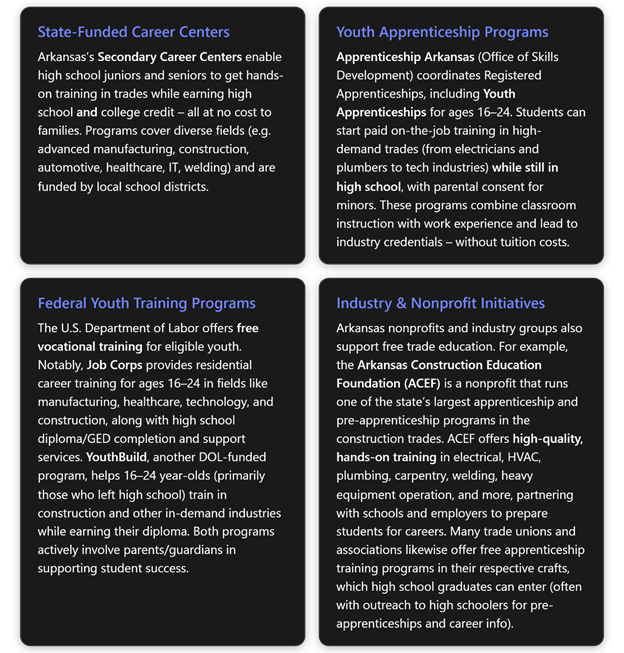
1. Arkansas High School Career Centers (Secondary Career Centers): These are state-funded technical centers located across Arkansas, typically hosted by community colleges or school districts. High school students (usually 11th–12th grade) attend part-time to learn career skills and even earn college credits while in high school. Programs are free (funded by the state/local district) so neither students nor parents pay tuition. Available trades and programs vary by center but span advanced manufacturing, automotive technology (collision repair and service), construction trades (including HVACR and drafting/CAD), welding, computer networking & programming, nursing and medical services, emergency responder training, and more. Every region has a career center – for example, the Conway Area Career Center offers construction technology, welding, and medical services training, among others. Parents can coordinate with school counselors to enroll their students in a nearby career center. These centers often hold parent nights or provide counselors who guide families through the process of starting a vocational program.
2. Apprenticeship Arkansas (Registered & Youth Apprenticeships): Arkansas’s Office of Skills Development (OSD) oversees Registered Apprenticeship programs (RAP) statewide in partnership with industry. Apprenticeships are paid training programs where students learn a trade under a skilled mentor and complete related classroom instruction, leading to journeyman-level certification. All registered apprenticeships are free to participate in (employers and/or public grants cover training costs), and apprentices earn wages as they train. For high schoolers, the state promotes Youth Apprenticeships, which let 16–17-year-old students start apprenticeship training while still in school. For example, a student might spend part of the week working as an apprentice electrician or mechanic and the rest in school. The program adapts hours to youth schedules (waiving the usual 2,000-hour/year requirement) and requires a parent or guardian’s consent for minors. Trades available: Apprenticeships exist in nearly every industry – traditional skilled trades like electrician, plumbing, HVAC, carpentry, welding, advanced manufacturing (e.g. machining, industrial maintenance), automotive, information technology, healthcare (e.g. nursing assistant), and more. To find opportunities, students and parents can use the state’s apprenticeship finder or contact the State Apprenticeship Office (see table) for help connecting with programs in their area. Many Arkansas employers partner with high schools and OSD to offer these slots, giving students a head start on a career with earning-while-learning. [arkansasosd.com]
3. Federal Programs (Job Corps and YouthBuild):
- Job Corps (Arkansas) – Job Corps is a federally funded program providing free education and vocational training to youth ages 16–24. Arkansas is served by centers such as the Little Rock Job Corps Center, which offers hands-on training in trades like construction, welding, facility maintenance, carpentry, plumbing, electrical, as well as healthcare (CNA, medical office), automotive repair, office administration, and IT. Students can also earn a high school diploma or GED on campus. Housing, meals, and basic medical care are provided free as needed, since Job Corps is typically residential. The program works closely with parents/guardians – they have admissions counselors who will answer parent questions and an orientation process that involves family support. For an in-school teenager, Job Corps might be an option after graduation or if traditional school isn’t working out. Interested students must meet income and eligibility criteria. Parents can contact Job Corps via the toll-free number or website for guidance on enrollment. [careeronestop.org] [littlerock…bcorps.gov]
- YouthBuild (Arkansas) – YouthBuild is another DOL-funded community-based pre-apprenticeship program targeting 16–24-year-olds who do not have a high school diploma. Participants work toward their GED or diploma while learning job skills, primarily in construction trades, though some programs include other industries like healthcare or IT. They gain experience by building or rehabbing affordable housing in their communities as part of the training. In Arkansas, for example, YouthBuild Little Rock (run by the Little Rock Workforce Development Board) provides training in construction (with NCCER construction certifications), CDL truck driving, certified nursing assistant (CNA), and other pathways. YouthBuild Hot Springs (Garland County), operated by the non-profit Community Services Office, similarly focuses on construction and healthcare career training for local out-of-school youth. All YouthBuild services are free, and enrollees often receive a stipend or wages while in the program. Since these programs cater to out-of-school youth, they are an option if a student has dropped out or for recent grads under 25 looking for a second chance at education and skills. Parents can get information from the local YouthBuild staff about enrollment; the programs often have orientations to involve family support. [dol.gov] [dws.arkansas.gov] [csoark.org],
4. Industry and Nonprofit Training Programs: Beyond school and government programs, Arkansas has industry-driven initiatives open to high school students or recent graduates, often at no cost:
- Arkansas Construction Education Foundation (ACEF): ACEF is a non-profit apprenticeship training trust that partners with high schools and employers statewide. It offers apprenticeship and pre-apprenticeship training in numerous construction trades – including electrical, HVAC, plumbing, carpentry, concrete finishing, diesel mechanics, crane operation, and heavy equipment operation. With multiple training sites across Arkansas and over 900 apprentices enrolled, ACEF is a major avenue for youth to enter the construction field. High school seniors can often start through ACEF’s pre-apprenticeship (earning high school credit or through SkillsUSA competitions), then transition into a registered apprenticeship after graduation. Cost: Tuition is typically covered by partnering employers or grants, so it is free or minimal for the student. ACEF also engages parents by explaining the lucrative career pathways in construction – for instance, an electrician apprentice can earn wages from day one and become a licensed journeyman without college debt. Interested families can reach out directly to ACEF for information on programs and partnering high schools. [arkansasnext.com]
- Other Trade Apprenticeships (Union & Industry): Many trade unions in Arkansas run joint apprenticeship training programs (JATCs) – for example, the IBEW for electricians, Plumbers and Pipefitters UA Local 155, or the Ironworkers union. These programs are tuition-free (funded by union and employers) and generally open to young people 18+ with a high school diploma. While still in high school, students can connect with such programs through career fairs or pre-apprenticeship agreements. Similarly, non-union companies in skilled trades (machining, manufacturing, IT, etc.) often have internships or trainee programs for high schoolers in partnership with state initiatives. The key is that Arkansas’s apprenticeship system encompasses a wide array of trades – virtually “all trades available in the state” have some training pathway a student can pursue. Parents and students can consult the Apprenticeship Arkansas office or local career counselors to identify specific trade programs of interest. (For example, if a student wants to be an HVAC technician, the office can refer them to an HVAC apprenticeship program in their region, whether via a union, ACEF, or an employer-led program.) [arkansasosd.com]
The following table summarizes free vocational programs for Arkansas high schoolers, with contact information for each. Parents and students should reach out to these contacts or visit the websites for further guidance on eligibility and enrollment:
| Program / Resource | Phone | Website | |
| Arkansas High School Career Centers *State Dept. of Commerce (OSD) – Secondary Career Education programs at various sites statewide for grades | 501-683-1152 | aceosdgrants@arkansas.gov | arkansasosd.com/centers [arkansasosd.com] |
| Apprenticeship Arkansas (Youth & Registered Apprenticeships) *State Office of Skills Development – info on apprenticeships | 501-683-1152 | Derrick.Daniels@arkansas.gov | arkansasosd.com/apprenticeship [careeronestop.org], [careeronestop.org] |
| Arkansas Construction Education Foundation (ACEF) *Nonprofit apprenticeship training in construction trades (elect | 501-372-1590 | laura@myacef.org | myacef.org [arkansasnext.com], [arkansasnext.com] |
| Job Corps – Little Rock Center *Federal program with free residential vocational training for youth 16–24 | 800-733-5627 | (Contact via phone or website) | littlerock.jobcorps.gov [careeronestop.org] |
| YouthBuild Little Rock Free DOL-funded program for ages 18–24 (focus on construction, GED prep; run by Little Rock WDB) | 501-320-3057 | (Contact via LR Workforce) | lrworkforce.com (Youth Programs) [dws.arkansas.gov], [dws.arkansas.gov] |
| YouthBuild Hot Springs (Garland County) *Free program for ages 16–24 (construction & healthcare training with diploma/GED support | 501-624-5724 | (Contact via CSO Hot Springs) | csoark.org/youthbuild [csoark.org], [csoark.org] |
Note: All programs above are completely free of charge. Funding comes from public education budgets, government grants (WIOA, DOL), or industry sponsorships. This means students can participate without paying tuition – a crucial benefit for families. It is recommended that students talk with their school’s career counselor or reach out to the program contacts to learn about application steps and start dates. Many programs have specific entry points (for example, career center courses begin at the start of a semester; apprenticeships and Job Corps accept applications year-round).
Arkansas’s robust network of career and technical education ensures that high schoolers can jumpstart a trade career early on. Whether a student is interested in welding, nursing, automotive repair, computer networking, or any other trade, there is likely a free program to help them gain real skills and credentials before graduation. By taking advantage of these resources – and with parents and educators providing guidance – students can graduate high school with a clear, supported pathway into a well-paying skilled trade profession. [arkansasosd.com], [careeronestop.org]