Revving Up Your Future: How to Start a Career as an Auto Mechanic
Do you love cars and working with your hands? A career as an auto mechanic could be your road to success. Auto mechanics (also known as automotive service technicians) keep the world moving by repairing and maintaining cars and trucks. It’s a high-tech, rewarding profession – modern mechanics use advanced computers and diagnostics as much as wrenches. Best of all, it’s a path you can start right in high school and grow into a well-paying career without a four-year college degree.
Getting Started: Education and Training
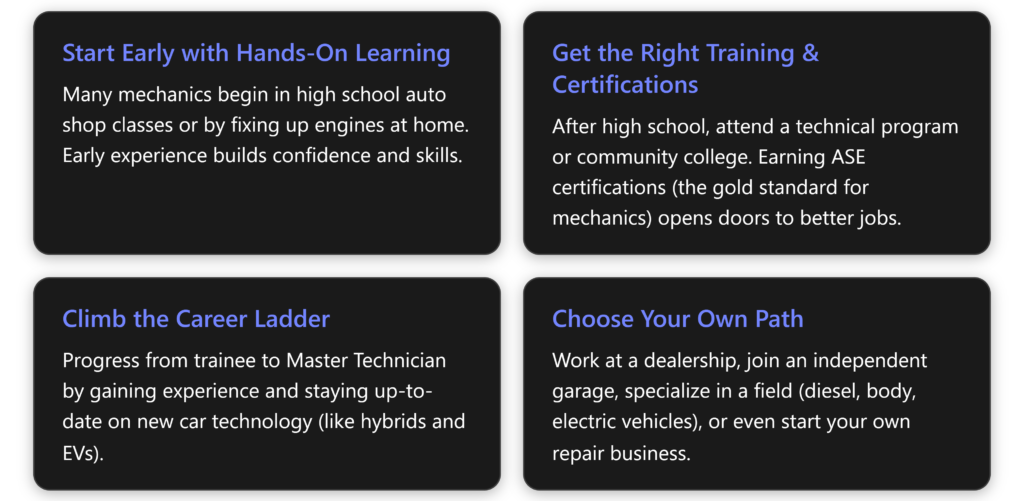
High School – The Perfect Place to Begin: Many auto mechanics discover their passion in high school. If your school offers automotive shop classes or a career & technical education (CTE) program in auto repair, sign up! You’ll learn the basics of car systems, tool use, and safety. Even if your school doesn’t have an auto program, you can start learning on your own:
- Join an after-school auto club or workshop: Some communities and schools have clubs where students rebuild engines or work on project cars.
- Work on bikes or small engines: Tinkering with a lawnmower or dirt bike engine can teach fundamentals that apply to cars.
- Find a mentor: Maybe a family member or friend loves fixing cars – ask if you can help out. Changing oil or replacing brake pads under supervision is priceless experience.
- Study online: Platforms like YouTube and free automotive courses can teach you how engines work and demonstrate basic repairs. (Always be safe and get an adult’s help for real repairs.)
Focus on STEM Classes: Being an auto mechanic today also means being comfortable with technology. Physics, math, and computer classes can help you understand things like engine calculations or electronic diagnostics. For instance, modern cars have many electronic control units, so a basic understanding of computers or even coding can be a bonus.
Explore Youth Programs: In the US, some high schools partner with industry programs to train young mechanics. For example, the Automotive Youth Educational Systems (AYES) is a partnership that can connect students with local dealerships for internships. These programs often let you work part-time at a repair shop as a student, turning your classroom knowledge into real-world practice.
After High School: Technical Schools and Certifications
Graduating high school is just the beginning. The next step is getting specialized training and certifications that prove your skills to employers:
- Attend a Community College or Technical Institute: Plenty of schools offer automotive technology programs that last about 1–2 years. You can earn a certificate or an Associate’s degree in Automotive Technology. In these programs, you’ll dive deeper into engine repair, transmissions, electronics, and more. Many community colleges have partnerships with manufacturers or local auto shops, which can help with job placement or apprenticeships. For example, some colleges participate in Toyota’s T-TEN or GM ASEP programs, where students get brand-specific training and internships at dealerships.
- Earn ASE Certifications: ASE stands for National Institute for Automotive Service Excellence – it’s the industry standard for mechanic certification. Think of ASE certificates as badges that show you know your stuff. There are ASE tests for different specialties: brakes, engine repair, electrical systems, heating and air conditioning, etc. Typically, a new mechanic might start working and, after gaining some experience (often two years), take an ASE test in a specific area. There’s even an ASE Entry-Level Certification for students just out of school, which helps show your foundational knowledge. As you pass more ASE exams and gain experience, you can become a Master Technician (earned when you achieve ASE certification in a series of core areas like Engine Repair, Transmissions, Drivetrain, Brakes, Suspension & Steering, Electrical, Heating & A/C, and Engine Performance).
Tip: Many mechanics keep learning and take refresher courses because ASE certifications need to be renewed every few years – cars are always evolving! - Manufacturer Training Programs: If you land a job at a car dealership (say Ford, Toyota, or BMW), they often have their own training courses. Manufacturers will send mechanics to special classes to learn the ins-and-outs of that brand’s vehicles. These are great for learning cutting-edge technology (like the latest electric models) and can often count toward ASE certification or other credentials.
Real-World Example:Meet Jordan. He wasn’t sure about a four-year college, so after high school he enrolled in a 2-year automotive technology program at his local community college. He learned everything from engine rebuilds to working with computerized diagnostics. In his second year, Jordan passed the ASE test for Engine Repair. “That first ASE certification felt amazing – like I’d proven to myself I could do this as a career,” he says. With a certificate and an ASE under his belt, Jordan got hired at a local Chevy dealership right after graduation.
Climbing the Ladder: From Newbie to Master Mechanic
When you start your first job as a mechanic, you’ll likely be an entry-level technician (often called a lube tech or maintenance tech). At this stage, you’re doing basic but important work: oil changes, tire rotations, replacing batteries, and assisting senior mechanics. It’s your chance to get used to a professional shop environment, build your tool collection, and refine your skills. Don’t worry, everyone starts with the basics.
As you gain experience and certifications, you move up:
- Automotive Technician (Mid-Level): After a couple of years, you’ll be able to handle more complex jobs like diagnosing check-engine lights, fixing brake systems, or repairing cooling systems on your own. You might have a few ASE certifications by now. Many shops have levels (Tech I, Tech II, etc., or titles like “Junior Technician” and “Senior Technician”). Moving up these ranks usually means you can work faster and tackle tougher problems. It’s a visible sign of your growing expertise.
- ASE Master Technician (Advanced): Achieving Master Tech status is a big milestone. This usually means you have passed a series of ASE certification exams (often 8 core areas) and have solid years of experience (often 5+ years in the field). Master Techs are the go-to people for diagnosing the trickiest issues. For example, if a car has a mysterious stalling problem that others can’t figure out, a Master Tech will likely be the one to crack the case. They often mentor junior techs and may specialize in areas like high-performance engines or advanced diagnostics. Master Techs command respect – and a higher paycheck.
- Shop Foreman or Lead Technician: In larger garages or dealerships, the most experienced mechanics might become a shop foreman or team leader. In this role, you still fix cars, but you also oversee other mechanics’ work, ensure the quality of repairs, and help train newcomers. It’s a step toward management while still staying hands-on.
- Service Manager or Owner: Some mechanics eventually move into management. A Service Manager runs the entire service department – scheduling work, interacting with customers, and managing the team of technicians. Other experienced mechanics choose to open their own repair shop after years of building expertise and saving up some money. Being your own boss can be very rewarding, though it comes with the challenge of running a business (finding customers, ordering parts, etc.). Often, mechanics who go this route have ten or more years of field experience and a strong network of loyal customers.
Throughout this journey, continuous learning is key. Cars today are vastly different from cars 15 years ago – and in 15 years they’ll be different again. Top mechanics attend workshops or online courses to learn about things like electric vehicle maintenance, new diagnostic tools, or advanced driver-assistance systems. The field keeps you on your toes, which is great for people who love learning new tech. As one veteran mechanic puts it, “Every year there’s something new to master – it never gets boring in this job!”
What You Can Earn: Mechanic Salaries at Each Stage
One big question students (and parents) have is: How much money can you make as an auto mechanic? The good news is that skilled mechanics can earn a comfortable living, and you can start earning money fairly quickly in this trade. However, salaries vary based on experience, certifications, and where you work. Let’s break down the potential earnings as you advance:
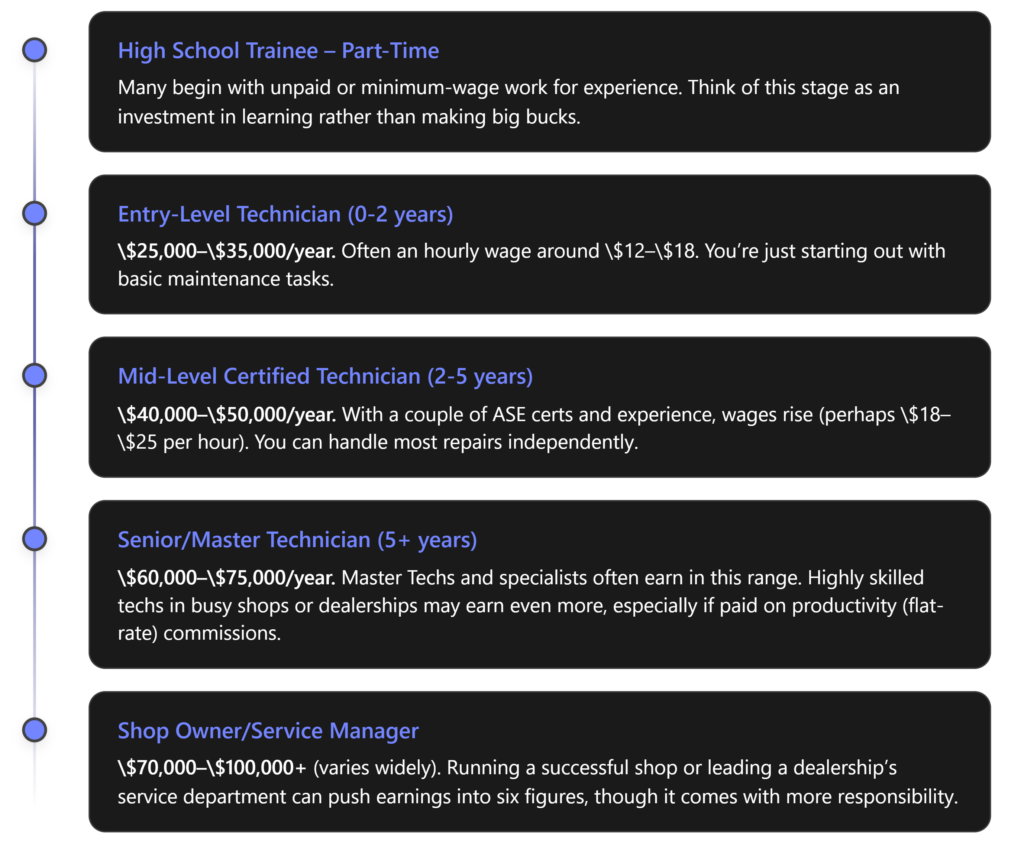
Keep in mind these numbers are approximate averages in the U.S. Actual salaries depend on factors like location (mechanics in big cities or high-cost areas often earn more), the employer (dealerships might pay more than small independent shops, but not always), and your specialty. According to the U.S. Bureau of Labor Statistics, the median annual wage for automotive service technicians was around $46,000 in recent years, which means half of mechanics earn more than that, and half earn less. With motivation and continuous improvement, it’s very possible to move toward the higher end of the pay scale over time.
To visualize how a mechanic’s pay grows with experience, check out the chart below showing typical salary ranges at different career stages:
- Entry-level (~$30,500/year) — based on low‑range annual earnings reported in a comprehensive salary guide. [api.asm.skype.com]
- Mid‑career median ($49,670/year) — U.S. median annual wage for automotive service technicians and mechanics. [Automotive…es In 2024]
- Experienced (~$77,000/year) — upper-range salary cited for seasoned mechanics with more years of experience and training.
![[api.asm.skype.com]](https://api.asm.skype.com/v1/objects/0-wus-d5-0431d22c0703fc99893d5610815f2074/views/original/generated_image.png)
Above: Approximate annual earnings for auto mechanics, from entry-level to experienced roles. Each stage assumes full-time work and relevant certifications.
Earnings Tips: One cool thing about this field is that you can earn while you learn. Unlike some careers where you must spend four years in college (often accruing debt) before making money, auto technicians start earning as soon as they start working. As your skills grow, your paycheck grows. Many mechanics also can earn extra income by working overtime or side jobs (like helping friends with repairs on weekends). And if you eventually open your own shop, your income will depend on the success of the business – which can be higher, but isn’t guaranteed, so gaining solid experience and a good reputation first is important.
Different Roads: Career Paths in the Automotive Field
One size doesn’t fit all in the automotive world. Part of what makes this career exciting is the variety of paths you can take. Here are a few directions an auto mechanic career can go:
- Dealership Technician: Working at a car dealership (e.g., a Ford or Toyota dealer) often means you specialize in that manufacturer’s vehicles. The dealership may send you to official training courses for new models and technology. Dealership techs often have access to the latest tools and a steady flow of cars to work on (since many car owners go to the dealer for service, especially during warranty). You might start as an express service tech (handling quick oil changes and inspections) and work up to a certified master for that brand. Example: Alicia works at a BMW dealership. She started through BMW’s own tech training program and now is the go-to person for hybrid BMW repairs in her shop.
- Independent Repair Shop Mechanic: These are your neighborhood garages that service all kinds of makes and models. Here, you’ll see a wide variety of issues – a Honda with a starter problem in the morning, a Chevy truck brake job in the afternoon, maybe a classic car carburetor tuning by evening. It’s great for developing broad skills. You might eventually specialize in being the “electrical expert” or “transmission guru” of the shop depending on what you excel at. Independent shops can be smaller and a bit more relaxed than dealerships, but advancement might mean eventually becoming the lead tech or manager as someone retires.
- Specialty Shop or Niche Skills: Some mechanics focus on a particular niche:
- Auto Body and Collision Repair: If you prefer hammers and paint to engines, you might go into auto body work, repairing accident damage. (This is often a separate trade, but some mechanics cross-train in both mechanical and body repair.)
- Diesel and Heavy Vehicle Mechanic: Big rigs, buses, and heavy equipment need mechanics too – usually diesel engine specialists. This requires additional training on diesel engines and heavy duty systems. Diesel techs often earn high wages due to the specialized skills.
- High Performance or Custom Tuning: Love racing or custom cars? Some mechanics specialize in performance tuning, working in speed shops to install turbochargers or do engine builds for race cars. It’s a more specialized market, often pursued after mastering general repair skills.
- Motorcycle/Marine Mechanic: A different path altogether, but some auto mechanics transition to or start in motorcycle repair or boat engine repair. The fundamental engine skills carry over, with new specifics to learn.
- Emerging Field – Electric Vehicle (EV) Specialist: The auto industry is rapidly shifting toward electric cars. This opens a new specialization for mechanics: EV maintenance and battery technology. EVs don’t have oil changes or traditional engines, but they have complex electrical systems and high-voltage batteries. By taking courses on EV technology (some colleges now offer them, and manufacturers like Tesla or Nissan have EV training), you could become an in-demand EV technician. This is a cutting-edge area – great for young mechanics who want to be at the forefront of technology. Insight: Even existing mechanics are retraining to work on hybrids and EVs. As more electric cars hit the road, shops will need technicians who understand them.
- Starting Your Own Business: After several years of experience, you might dream of opening your own garage. Many auto shop owners began as mechanics, then took the leap to entrepreneurship. Running your own shop means you get to call the shots and potentially earn more from the business’s profits. However, it also means handling business tasks – managing finances, marketing to get customers, and making sure every repair is top quality to build a good reputation. If you have a mix of mechanical skill and business savvy (or you’re willing to learn), this can be the pinnacle of an auto mechanic career. Some even start businesses like mobile mechanic services (where you drive to the customer for basic repairs) or specialty restorations (fixing up classic cars for collectors).
Final Tune-Up: Advice for Aspiring Mechanics
Embarking on the journey to become an auto mechanic is exciting. Here are a few final tips and encouragements for students (and their parents):
- Stay Curious and Eager to Learn: The best mechanics are always learning. Don’t be afraid to ask questions from experienced techs. Every repair job is a chance to improve.
- Invest in Your Tools and Skills: Good tools make the job easier – over time, start building your own tool set (many shops require mechanics to have their own basic tools). Also consider special training if you find an area you love (for example, take an extra course in performance tuning if that interests you).
- Be Patient in the Process: It might take a few years to become really confident and proficient. That’s normal! No one learns everything overnight. Focus on doing quality work and the speed and earnings will increase with time.
- Pride and Passion: There’s great pride in fixing a car and seeing it run smoothly because of your effort. Mechanics often talk about the satisfaction of solving a tough problem or helping someone get back on the road safely. That sense of accomplishment is a huge reward of the job.
- Job Security: Cars will be around for a long time, and they’ll always need fixing. As long as you keep your skills up-to-date, you’ll have a skillset that’s in demand. And skilled tradespeople (like mechanics) can often take their skills anywhere – every city and town needs mechanics, so you have flexibility in where you live.
In conclusion, starting a career as an auto mechanic in high school and growing it into a profession is an achievable goal. With the right mix of education, on-the-job training, and certifications, you can advance from an eager beginner to a seasoned expert. It’s a career with many pathways – each with its own rewards – whether it’s working on cutting-edge electric vehicles, becoming the neighborhood’s trusted car doctor, or running your very own garage. For students who love cars, problem-solving, and hands-on work, this is a journey that can lead to a fulfilling and lucrative future. So roll up those sleeves, grab a wrench, and start turning your passion for cars into a career!
