
Think HVAC Might Be for You?
HVAC (Heating, Ventilation, and Air Conditioning) is a hands-on field that keeps people cool in summer and cozy in winter. It’s a great career if you like working with tools, solving practical problems, and don’t want to spend four years in college. Here’s a friendly guide on how to get started, grow, and cash in on a career in HVAC—aimed at students (and parents) curious about this path.
Getting Started in HVAC: School vs. Apprenticeship
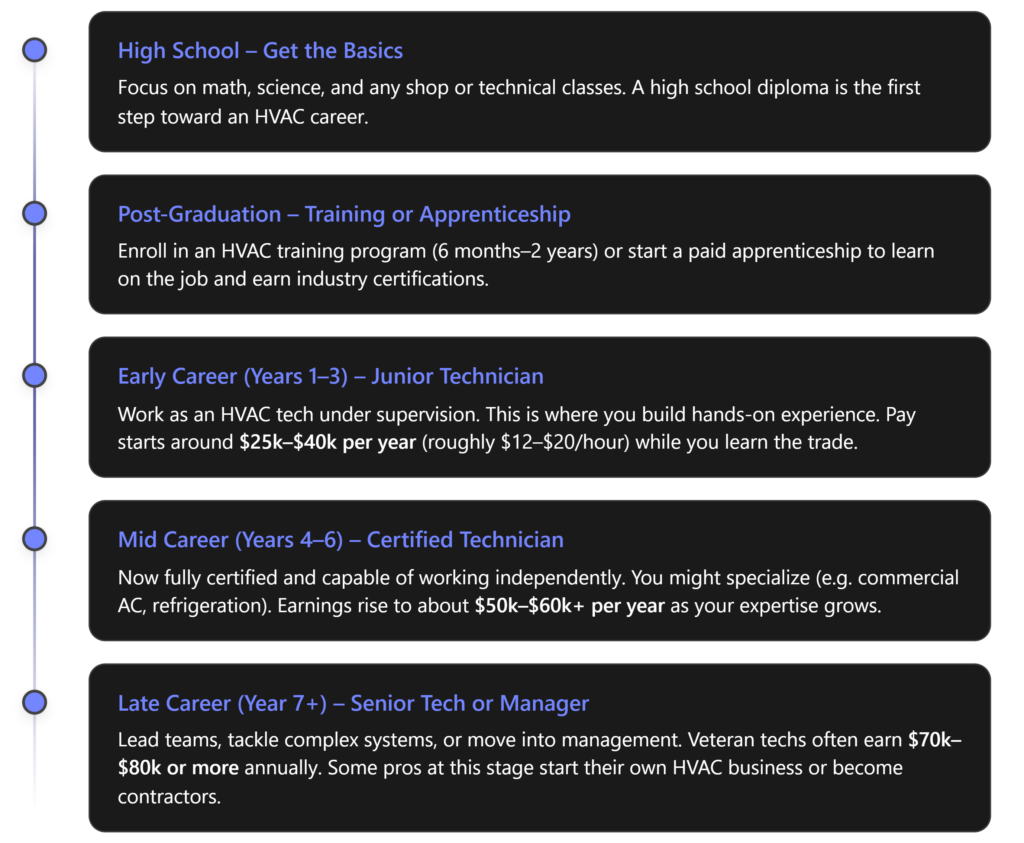
Education & Training: Most HVAC pros start after high school – a diploma or GED is usually the minimum. In high school, take shop class (if available), and focus on basic math and science (physics and chemistry help when understanding heating/cooling). After that, you have two main routes:
- 🏫 Technical School/College: Many community colleges and trade schools offer HVAC programs (lasting ~6 months to 2 years). Here you’ll learn the fundamentals of refrigeration, electrical systems, and how to use HVAC tools. You might earn a certificate or associate degree. Bonus: some programs include internships for real-world experience.
- 🔧 Apprenticeship: This is a “learn-and-earn” approach. You work under an experienced HVAC technician as a paid apprentice, typically for 3-5 years. No hefty student loans – you get paid (though modestly) while getting on-the-job training. For example, apprenticeship starting pay might range from $15–$20 an hour depending on your region. As you gain skills, your pay increases. Apprenticeships might be run by local HVAC companies, unions, or contractor associations. Certifications: Early on, you’ll need certain certs. The big one is an EPA Section 608 certification (required by U.S. law to handle refrigerants – the chemicals in AC units). This is often built into school programs or apprenticeships. There are also other credentials like NATE (North American Technician Excellence) certification, which can boost your credibility as you advance.
Getting Your Foot in the Door: Some start as HVAC helpers/assistants right out of high school – basically a trainee who helps a tech on service calls (handing tools, carrying materials) and learns the ropes. It’s a good way to see if you enjoy the work. Many helpers then either formally apprentice or go to night school for HVAC while working.
Climbing the Ladder: From Newbie to Pro
Entry-Level: As a new HVAC technician, your first role might be as a “Junior Tech” or Apprentice. You’ll assist with installing units, cleaning systems, changing filters, and basic repairs, usually under a mentor’s guidance. Expect to do a lot of learning. At this stage, you’re building the foundation – understanding how HVAC systems work in real life and developing troubleshooting skills.
Advancing Your Career: HVAC has a clear progression, though not always with formal titles. After a couple of years, you become a fully qualified Technician (often called a “Journeyman” in trades). This means you can independently install, diagnose, and repair HVAC systems. With a solid reputation, you might handle bigger projects or even mentor newer techs.
From there, you can move up to Senior Technician or Crew Leader. These folks take on the complex jobs (like sophisticated climate control systems in big commercial buildings) and often coordinate other techs on the job site. Some senior techs choose to go into management – for example, becoming a service manager or project manager who schedules jobs, orders equipment, and manages customer relationships for an HVAC company.
Specializations: Advancement isn’t only about moving “up” into leadership – you can also move deep into a specialty. Some areas to specialize in:
- Residential vs. Commercial: Residential techs work on home HVAC units; commercial techs handle systems in offices, schools, stores (often larger and more complex systems). Commercial specialists might earn more due to the complexity of the work.
- Refrigeration: Some techs focus on refrigeration systems (like those in supermarkets or ice rinks) – this is often referred to as HVAC/R (R for refrigeration). Specialized refrigeration techs are in high demand and can command high wages.
- HVAC Controls/Automation: With smart thermostats and automated building systems on the rise, some technicians specialize in the electrical controls and software that run HVAC systems. This blend of IT and HVAC is a growing niche.
- Green Energy & Design: Interested in eco-friendly tech? HVAC pros can specialize in solar heating, geothermal systems, or energy efficiency retrofits. There’s also work in designing high-efficiency systems for new green buildings (often this requires working with or as an engineer).
No matter which route, gaining certifications in your specialty (e.g., a certificate in commercial refrigeration) will accelerate your progress.
Show Me the Money: Earnings at Each Stage
One big question: How much can I earn in HVAC? Good news – HVAC pays well as you move up. You’ll likely start with a modest wage as you train, but experienced HVAC techs can earn salaries comparable to jobs that require a college degree.
To keep it simple, here’s a look at potential earnings as you grow in the field:
| Career Stage | Role Description | Typical Pay |
| Trainee / Apprentice | Learning the ropes under supervision. Often a helper on jobs. | ~$12–$18 per hour (≈ $25k–$35k/year) |
| Junior Technician | Can do basic installations and repairs with some guidance. | ~$18–$25 per hour (≈ $35k–$50k/year) |
| Experienced Technician | Fully independent (journeyman level), 3–5+ years experience. Handles most repairs/installations solo. | ~$25–$35 per hour (≈ $50k–$70k/year) |
| Senior Tech / Supervisor | 5–10+ years. Expert in complex systems, may lead a team or project. | ~$30–$45 per hour (≈ $60k–$90k/year) |
| Business Owner / Contractor | Runs an HVAC business, bids jobs, manages crew. Income comes from profits. | Varies widely: successful owners can earn $100k+ per year, but it depends on business size and success. |
Note: These are rough ranges for the U.S. as of mid-2020s – actual pay varies by region and employer. Urban areas or union jobs might pay on the higher end, and places with lower cost of living or entry-level positions might be on the lower end. Overtime can also boost earnings; HVAC folks often earn extra in peak summer or winter seasons by working OT or emergency calls.
Here’s some context: According to industry data, a new HVAC tech might start around $30,000 a year, while the median annual wage for HVAC technicians nationwide is around $50,000 (meaning half earn more, half earn less). Skilled techs in high-demand areas can make over $70,000 a year. And if you eventually run your own company, the sky’s the limit – some owners make well into six figures.
Different Paths within HVAC
One of the cool things about HVAC is variety – it’s not one-size-fits-all. You can tailor your career to fit your interests and strengths. Here are a few career paths in the HVAC world:

Of course, these paths can overlap. For instance, an HVAC business owner often started as a service tech or installer and may still jump in to help on complex jobs. Or a system designer might also do sales consulting for energy-efficient systems. The key point is, HVAC isn’t a dead-end job – it’s more like a choose-your-own-adventure in the broad HVAC universe.
Why HVAC is a Cool (and Hot) Career in the US
Strong Demand: HVAC technicians are needed everywhere – from sweltering Texas summers to frigid Minnesota winters. Heating and cooling aren’t luxuries; they’re necessities, and systems always need installing or fixing. The U.S. is seeing a shortage of skilled tradespeople (like HVAC techs) as many older workers retire. That means opportunity for young people: job openings are plentiful, and employers are eager to train hardworking newbies.
Good Pay & Growth: As we saw, the pay starts decent and becomes really good as you gain experience. Plus, you can often start earning sooner than friends who go to a 4-year college (you might be 20 years old and earning while they’re still in school). The Bureau of Labor Statistics projects steady growth in HVAC jobs through the decade as construction expands and older systems get replaced. In short, it’s a future-proof trade – heating and cooling isn’t going anywhere.
No Desk Required: Many students aren’t excited about sitting at a desk all day. If you prefer being active, working with tools, and being out in the field, HVAC offers that. It’s sometimes tough (you might be in hot attics or on chilly rooftops), but a lot of techs enjoy that it keeps them fit and active, not stuck in a cubicle.
Regional Differences: While HVAC jobs exist in every state, there are some differences:
- In hot climates (think Florida, Arizona), AC work is king – there’s tons of work installing and servicing air conditioners.
- In cold climates (northern U.S.), heating (furnaces, boilers) and insulation are big.
- Year-round demand: Many areas need both heating in winter and AC in summer (hello, Midwest!), so an HVAC tech’s skills are useful year-round.
- Pay varies by region: generally, big cities or union jobs pay more (higher cost of living, more commercial projects), whereas small towns might pay a bit less. For example, someone in New York or California might earn more than someone in Mississippi for the same work but remember the cost of living differs too.
Advancement & Entrepreneurship: HVAC is a trade where experience really counts. The longer you do it (and the more you keep learning), the more valuable you become. Ambitious? You can get licensed as a contractor and open your own shop. Many HVAC business owners start with just themselves and a van and grow to employ others. Being your own boss in your 30s is quite possible in this field.
Bottom Line: HVAC is a rewarding career path that offers a mix of stable demand, good salaries, and multiple ways to grow. You can start quickly out of high school, avoid massive college debt, and build a comfortable life for yourself. Whether you want to work with your hands every day, aim for management, or eventually run your own business, the HVAC field has a path for you. So stay cool, keep learning, and you just might become the go-to HVAC hero in your town!
