Overview: Blue-Collar Careers in the U.S. Merchant Marine
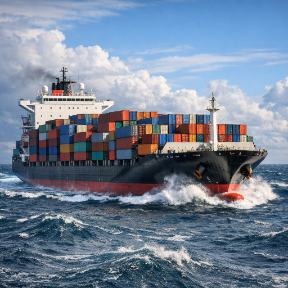
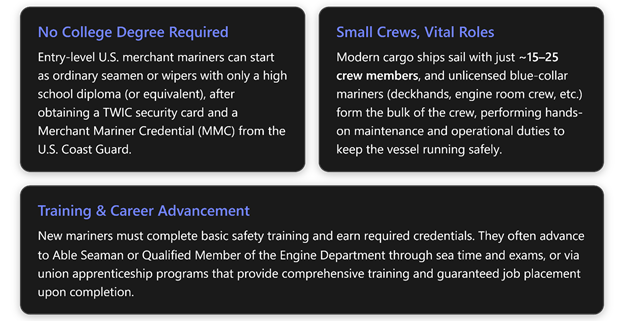
The U.S. Merchant Marine employs many blue-collar technical roles – crew members who work in hands-on capacities to operate and maintain commercial ships. These unlicensed mariners (often called ratings or seamen) do not need a college degree, yet they are essential for a ship’s day-to-day functions. Modern commercial vessels are operated by relatively small crews (typically 15–25 people on large cargo ships) and rely on skilled blue-collar workers for vital tasks in three main shipboard departments: Deck, Engine, and Steward (Supply). The deck department handles navigation, cargo, and upkeep of the ship’s exterior; the engineering department runs the propulsion and mechanical systems; and the steward/supply department manages food services and living quarters. On a typical 20-person U.S. cargo ship, about half or more of the crew are unlicensed deckhands, engine-room crew, and stewards who directly maintain the vessel under the supervision of a smaller number of licensed officers.
Common Blue-Collar Roles Onboard
In the deck department, entry-level crew start as Ordinary Seamen (OS) (also known as deckhands). OS crew perform general ship maintenance – cleaning decks, chipping rust, painting, handling ropes, and assisting with cargo and mooring operations. With experience and sea time, an OS can upgrade to Able Seaman (AB), a more senior deckhand rating. Able Seamen are proficient in seamanship; they handle more complex tasks like operating cargo gear, steering the ship during watch, and leading maintenance or safety drills. Experienced ABs often serve as lookouts and helmsmen on the bridge and are crucial in emergency responses (e.g. launching lifeboats). The Boatswain (Bosun) is the senior unlicensed deck crewman who supervises the OSes and ABs. A Bosun (typically a seasoned AB) coordinates daily work on deck – overseeing cargo loading, directing maintenance/repair jobs, and training junior sailors.
In the engine department, the entry role is Wiper, the engine room’s equivalent of an OS. Wipers keep machinery spaces clean and assist with basic engine maintenance tasks. After gaining some experience, a wiper can become a Marine Oiler, which is one of the Qualified Member of the Engine Department (QMED) ratings. Oilers are responsible for lubricating and operating machinery, monitoring engine gauges and oil levels, assisting engineers with repairs, and performing routine mechanical maintenance to keep engines, boilers, and auxiliary systems running smoothly. On certain vessels, there are other specialized unlicensed engine-room roles (all under the QMED category) such as Electrician/Refrigeration Engineer or Pumpman/Machinist, which require additional skills to maintain electrical systems or cargo pumps.
The steward (supply) department includes roles like Chief Cook/Steward and Steward Assistant (Messman). These crew members handle “hotel” functions: preparing meals, managing the galley (kitchen), provisioning supplies, and maintaining living quarters for the crew. While these roles are not typically considered “technical” in the mechanical sense, they are blue-collar positions that also do not require a college degree.
All of these unlicensed mariner roles are considered entry-level or mid-level positions that one can pursue without a four-year degree. Instead of college, the emphasis is on acquiring the proper credentials, maritime training, and hands-on sea experience. The table below summarizes some common U.S. merchant marine blue-collar roles, their duties, and the requirements for entry and advancement.
| Role | Required Certifications/Training | Entry-Level Requirements |
| Ordinary Seaman (OS) Entry-level Deck Crew | MMC with OS endorsement (entry-level credential); STCW Basic Training (Basic Safety course) for ocean-going vessels; on-the-job training in seamanship. | Age 18 (16 minimum to qualify for MMC; most employers require 18), TWIC security card; USCG Medical Certificate (pass a physical & drug test). No prior maritime experience required |
| Able Seaman (AB) Experienced Deck Crew | MMC endorsement as Able Seaman (requires accumulated sea service as OS – typically 180 days for entry-level AB ratings, more for AB Limited/Unlimited – and completion of exams or approved course). Must hold Lifeboatman/Proficiency in Survival Craft certification (STCW lifesaving training) for the AB endorsement. STCW Basic Training and other safety courses are required for most deep-sea AB positions. | Prior sea experience (meeting USCG sea-time days requirement as OS or equivalent service) and demonstration of seamanship skills. Must pass a USCG AB proficiency exam or course. TWIC, medical clearance, and MMC (as OS first) are prerequisites. |
| Boatswain (Bosun) Lead Deckhand/Supervisor | No separate license (a bosun is an experienced AB). Requires extensive on-the-job training; typically a certified AB with significant experience. Often has additional training in shipboard safety, cargo operations, and maybe crane/forklift operation (depending on ship). | Progression from AB based on experience and leadership ability. Must have strong seamanship skills and supervisory capability. Essentially no college required – advancement is through experience and reputation. MMC with AB endorsement is required; leadership experience on deck is expected. |
| Wiper Entry-level Engine Room Crew | MMC with Wiper endorsement (entry-level engine rating, usually included in entry MMC); STCW Basic Training for most vessels. Wipers receive extensive on-the-job training in mechanical systems and may take basic marine engineering or safety courses through company or union programs. | Age ~18, TWIC card, and medical clearance (same entry requirements as OS. No prior experience needed for this entry-level engine department role. Willingness to perform manual, dirty work in engine spaces is essential. |
| Oiler (QMED) Qualified Engine Room Rating | MMC with Qualified Member of Engine Department (QMED) endorsement – typically in the Oiler category (requires specified sea service as a wiper or entry trainee and passing a USCG QMED exam). STCW certifications (Basic Training, etc.) are required for deep-sea vessels; additional specialized short courses (e.g. marine diesel engineering, pump operations) are often completed to prepare for QMED/Oiler duties. | Prior engine room experience (e.g. 6+ months as a wiper or equivalent trainee experience) to meet USCG sea-time requirements for QMED. Must pass a USCG QMED/Oiler exam (or approved course). TWIC, medical cert, and basic safety training are mandatory. Mechanical aptitude and familiarity with engine systems are expected. |
| Steward (Cook/Messman) Food Service Crew | MMC with Food Handler/Steward endorsement (entry-level steward department credential, often included in initial MMC). May require a ServSafe food handling certification or similar. Basic safety training (firefighting, first aid) is typically required as for all mariners. On passenger vessels, additional certifications (crowd management, crisis management) might be needed. | Age ~18, TWIC, medical clearance, and an entry-level MMC. No formal culinary degree required (though cooking experience is beneficial). Many stewards start as Steward Assistants/Messmen and learn on the job; with experience, they can become Chief Cooks. Good housekeeping and culinary skills are important. |
How to Become a Merchant Mariner (Blue-Collar Pathway): To join the U.S. Merchant Marine in any of these blue-collar roles, you must obtain a Merchant Mariner Credential (MMC) issued by the U.S. Coast Guard. This credential serves as your license to sail in various capacities. The process involves several steps:
- Meet Basic Eligibility: Be at least 18 years old (16 can apply for the MMC, but most ships hire 18+ for full duty) and pass a U.S. Coast Guard medical exam and drug test to ensure you are fit for duty. You must also undergo a background check and obtain a Transportation Worker Identification Credential (TWIC) from the Transportation Security Administration (this is required for port and vessel access).
- Decide on a Department/Role: Early on, choose between deck, engine, or steward department based on your interests. This decision guides the specific training and endorsements you’ll pursue. (For example, those aiming for engine crew might take additional engineering courses, while deck crew candidates focus on seamanship.)
- Complete Required Training: All mariners receive basic maritime safety training. This typically includes STCW Basic Training (Standards of Training, Certification and Watchkeeping – a weeklong course covering firefighting, first aid, personal survival techniques, etc.) required for ocean-going vessels. Many entry-level mariners also take short courses (often a week or two) in Basic Seamanship and Personal Safety/Social Responsibility, which are sometimes bundled in “maritime bootcamp” programs. These courses prepare you for life at sea and may cover marlinspike seamanship (line handling and knots), emergency procedures, and vessel terminology. While not always mandatory to get your MMC, such training greatly improves job readiness and hiring prospects.
- Apply for the MMC: Submit an MMC application (USCG Form CG-719B) along with documentation of your TWIC, medical exam, drug test, proof of citizenship, and any training certificates to the USCG National Maritime Center. The entry-level MMC will grant you the rating endorsements of Ordinary Seaman, Wiper, and Steward (Food Handler) – no prior sea service is required for these entry ratings. Once approved, you receive your MMC credential (a booklet) which serves as your official qualification to work in the respective roles.
- Find an Entry-Level Job or Apprenticeship: With an MMC in hand, you can start applying for entry-level positions. Many new mariners join through labor unions or company training programs. For example, the Seafarers International Union (SIU) offers an unlicensed apprentice program at its Paul Hall Center that provides 17 weeks of classroom training plus hands-on sea time; graduates earn credentials like Able Seaman or QMED and are guaranteed a first shipboard job through the union upon completion. This is a common pathway into blue-collar maritime careers. Other options include attending private or state-run maritime training schools (which offer accelerated courses and help with job placement), or seeking jobs with organizations like the Military Sealift Command (MSC), a branch of the U.S. Navy that operates civilian-crewed ships. MSC hires entry-level Ordinary Seamen and Wipers and provides on-the-job training; crew members can advance to Able Seaman or higher engine room ratings after completing required sea service and performance reviews in programs like MSC’s OS-to-AB or Wiper-to-Oiler advancement pipelines.
- Advance with Experience and Upgrading Credentials: Once employed, career advancement in these roles is achieved through accumulating sea experience and obtaining higher-level USCG endorsements. For instance, after 6–12 months of sea time, an OS can take an exam (or complete an approved course) to become an Able Seaman, which comes with more responsibilities and higher pay. Similarly, a wiper can work toward a QMED/Oiler endorsement after sufficient experience and training. Higher endorsements often require passing USCG-administered tests. Many mariners continue to climb the ranks (“hawsepipe” their way up), potentially moving into licensed positions like Third Mate or Third Assistant Engineer after several years – all without needing a college degree, by leveraging experience, additional courses, and Coast Guard exams.
Unions and Professional Support
Maritime unions and organizations play a key role in supporting merchant mariners in blue-collar jobs. The Seafarers International Union (SIU) is the largest union for unlicensed U.S. mariners in deep-sea, Great Lakes, and inland trades, representing most entry-level and seasoned ratings. SIU provides hiring halls, apprenticeship training (at Paul Hall Center), and access to jobs on union-contracted vessels. There are also specialized unions such as the Inland Boatmen’s Union (for West Coast inland mariners) and others like the Sailors’ Union of the Pacific (SUP) and Marine Firemen’s Union, which have regional or job-specific memberships. These unions often offer benefits, hiring assistance, and upgrading classes for their members.
Beyond unions, aspiring mariners can seek guidance from organizations like the Maritime Administration (MARAD) and state maritime academies. Even though the federal and state maritime academies primarily train licensed officers (a path that does involve a college degree), they also offer short training courses and credentialing assistance open to non-students. Additionally, many community colleges and private maritime schools (for example, Maritime Professional Training in Florida, or Seattle Maritime Academy) have programs in subjects like marine engineering technology, able seaman training, and tanker operations, which can jump-start a blue-collar maritime career. These programs typically culminate in the necessary USCG certifications (for instance, training for tankerman endorsement, welding certifications, etc.) and often include job placement support.
In summary, becoming a U.S. merchant mariner in a blue-collar role is an achievable goal with the right preparation. You will need to secure the proper credentials and training – starting with a TWIC and MMC for entry-level deck, engine, or steward roles – and then gain experience at sea. New mariners can either jump straight into the workforce as an Ordinary Seaman, Wiper or entry-level steward after basic training, or enhance their prospects through formal apprenticeship and training programs that provide both classroom instruction and sea time. Hard work and experience are the keys to moving up: by completing required sea service and passing Coast Guard exams, you can advance to Able Seaman, Oilers/QMEDs, or other specialized ratings, eventually even qualifying for officer licenses if you continue your professional development. The U.S. Merchant Marine offers a robust career path for those who prefer skilled, hands-on work at sea over a traditional college route, with plenty of support from maritime schools and unions to help you launch a rewarding seafaring career. [mmseas.com] [community.kaplan.com], [merchantmarguide.com]