From Service to Skilled Trades: How the Military Can Launch Your Blue-Collar Career
Introduction:
Not sure about college but still want a solid, well-paying career? Enlisting in the military might be the perfect launchpad for you. For high school students (or anyone with a high school diploma or GED), military service can build valuable skills and certifications that transfer directly into blue-collar jobs – the hands-on careers like construction, electrical work, HVAC repair, logistics, and building maintenance. The discipline and training you get in uniform can set you up for success in these fields, often with higher pay and more opportunities than you might get jumping straight into the job market. In this blog, we’ll explore how serving in the armed forces can be a stepping stone to a blue-collar career, backed by stats, examples, and an inspiring real-life veteran story.
Why Military Service Is a Great Path to Trades
Enlisting in the military after high school can feel like jumping into the deep end, but it comes with big benefits for a future trades career:
- Hands-On Training (and Getting Paid for It): The military is like the ultimate trade school – but you earn a paycheck. Nearly every branch offers technical roles. For instance, the Army has plumbers, electricians, and carpenters in the Corps of Engineers; the Navy trains construction battalions (the “Seabees”) in building and heavy equipment operation; the Air Force teaches HVAC and aircraft mechanics; and the Coast Guard trains electrical technicians (Electrician’s Mates) and machinery technicians. You’ll spend months learning your craft in advanced training schools. By the time you finish your service, you could have 4+ years of experience in a skill that’s in high demand back home.
- Discipline and Work Ethic: Waking up at 5 AM for physical training, following procedures, meeting strict quality standards – these habits become second nature. Employers in blue-collar fields (and any field, really) love veterans’ discipline and reliability. Showing up on time, ready to work hard, sets you apart. A construction site or workshop values someone who can dive into tasks with focus and get the job done right – exactly what the military instills in you.
- Leadership and Teamwork: In the military, even junior enlisted folks quickly learn to work in teams to solve problems under pressure. As you rise in rank, you take on leadership roles, supervising crews and projects. That leadership experience can lead to faster promotions in civilian jobs. For example, a veteran who led a motor pool maintenance team might become a crew chief or site supervisor more quickly in a trucking or repair company. Teamwork is huge in construction and maintenance jobs – a complex project (like building a house or repairing an aircraft engine) goes more smoothly when a team communicates well. Your military experience working in squads or units translates directly to being a reliable crew member.
- Certifications and Credentials: A big plus – you can earn certifications while in service. Military training often meets or exceeds civilian certification standards. For instance, if you train as an Army electrician, you cover the same material as civilian apprenticeship programs and can test for a state electrician’s license faster. Many military mechanics get Automotive Service Excellence (ASE) certifications as they train. If you drive heavy trucks in the Marines or Army, you can often walk away with a Commercial Driver’s License (CDL). These credentials mean when you apply for jobs after the military, you’ll have proof of your skills that civilian employers recognize immediately.
From Uniform to Work Boots: Transferable Skills
One of the best things about a military-to-trades path is how directly transferable the skills are. Here are a few examples of military jobs and how they set you up for civilian careers:
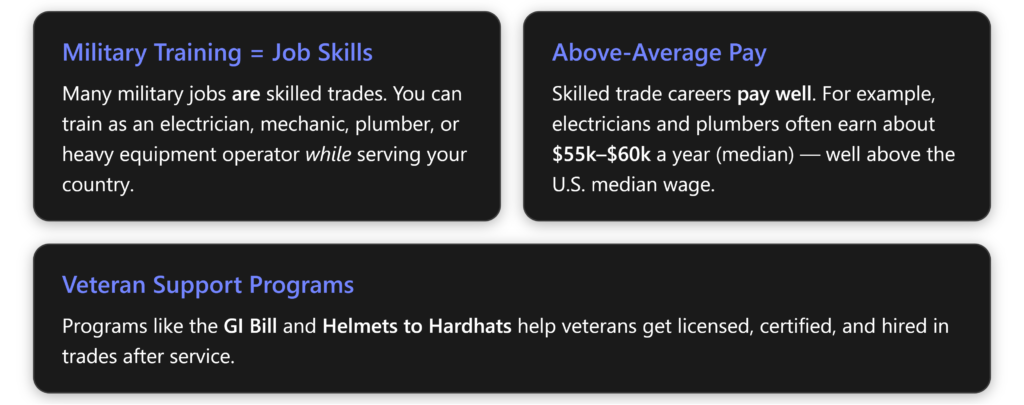
- Mechanical and Electrical Skills: If you were fixing Humvees or generator systems in the Army, you’ve basically been an auto or diesel mechanic already. If you maintained a ship’s electrical grid in the Navy or Coast Guard, you’ve been doing electrician work. These skills line up with jobs like automotive technician, diesel engine mechanic, or industrial electrician. According to the U.S. Bureau of Labor Statistics (BLS), civilian electricians earn a median salary around $60,000 per year, and diesel mechanics around $48,000 per year, so these are lucrative paths.
- Construction and Carpentry: The military builds a lot – airfields, barracks, even entire bases. As a Navy Seabee or Army engineer, you could learn carpentry, masonry, heavy equipment operation (bulldozers, cranes), and more. This can translate into construction jobs like carpenter, heavy equipment operator, or construction foreman. The construction industry is hungry for skilled workers – a large percentage of the current workforce is nearing retirement, so younger folks (especially disciplined veterans) are in demand to fill those spots.
- HVAC and Plumbing: Bases and ships need climate control and plumbing, just like any city or hotel. The Air Force has HVAC specialists maintaining heating and cooling on bases; the Navy’s utilitiesmen keep water and plumbing systems running. After service, you can step into roles as HVAC technicians or plumbers/pipefitters. These jobs pay well; for example, plumbers have median salaries around $59,000, and experienced HVAC techs can earn above $50,000 a year, with strong job growth expected as construction booms continue.
- Logistics and Trucking: Every military operation relies on moving people and stuff efficiently. If you served as an Army logistics specialist or a transport truck driver, you’ve managed inventory, driven long distances, and coordinated supplies – exactly what civilian logistics coordinators, warehouse managers, or CDL truck drivers do. The advantage: the trucking industry in the U.S. often has more jobs than drivers; veterans with a CDL can often get hired quickly, and some companies even have higher starting pay for vets. As of 2023, long-haul truckers have a median pay around $48,000-$50,000, but many earn more with experience or by driving specialized routes.
- Facility Maintenance: Every branch has large facilities that need kept up. If you worked in base facilities management or as a ship’s maintenance technician, you touched plumbing, electrical, HVAC, and more. That background can land you a job as a building engineer or facility maintenance tech in office buildings, hospitals, or schools. Those jobs often combine several skills (electrical, HVAC, carpentry) – exactly the jack-of-all-trades abilities many vets have.
Below is a comparison of some common blue-collar careers that military veterans (with only a high school diploma/GED) often excel in after service, showing how military roles line up with civilian jobs, what credentials you’d need, and the average salaries in those fields:
| Blue-Collar Career | Example Military Role | Certifications Needed (Civilian) | Avg. Salary (US) |
| Electrician | Coast Guard Electrician’s Mate (EM); Army Interior Electrician | State Electrician License (journeyman); Apprenticeship completion | ~$60,000/year (median) |
| HVAC Technician | Air Force HVAC Specialist; Navy Seabee Utilitiesman (HVAC) | EPA 608 Technician Certification; State HVAC License (in some states) | ~$50,000/year (median) |
| Plumber/Pipefitter | Army Plumber; Navy Utilitiesman (UT) | State Plumber License; Apprenticeship | ~$59,000/year (median) |
| Vehicle/Diesel Mechanic | Army Wheeled Vehicle Mechanic; Marine Corps Diesel Mechanic | ASE Certifications (e.g. diesel engines); Manufacturer-specific training (optional) | ~$48,000/year (median) |
| Truck Driver (CDL) | Army Motor Transport Operator; Marine Corps Logistics Vehicle System Operator | Commercial Driver’s License (CDL) | ~$48,000/year (median) |
| Building Maintenance | Navy Hull Maintenance Tech; Air Force Facility Systems Tech | Various (electrician license or HVAC cert boosts prospects) | ~$45,000–$55,000/year (varies) |
Sources: U.S. Bureau of Labor Statistics, 2022-2023 data (median salaries); career credential requirements from industry standards. Keep in mind salaries can vary by region and experience – e.g. union electricians or experienced plumbers can make $80k+ in some areas, and many trades offer overtime pay.
As you can see, the military roles and civilian jobs are closely aligned. With a high school diploma, you can get into those military roles early, learn by doing for a few years, and then come out and step into a good-paying job. In many cases, your military experience lets you skip entry-level positions. For example, a Navy-trained electrician might test for the journeyman license immediately rather than spending four years as an apprentice, because their military schooling and on-the-job training fulfills those requirements.
Support for Transitioning Veterans
The transition from military to civilian life can be challenging, but thankfully there are many programs and resources to help service members move into blue-collar careers:
- SkillBridge Program: The U.S. Department of Defense SkillBridge program allows service members in their last 6 months of service to intern with civilian companies or unions full-time while still getting military pay. Many use SkillBridge to start trade apprenticeships or job training. For example, a soldier can spend their last six months before discharge working with an electrical contracting company through SkillBridge — by the time they’re officially out, they might already have a job offer.
- GI Bill & Apprenticeships: You’ve probably heard the GI Bill helps pay for college, but it also supports vocational training and apprenticeships. GI Bill benefits can cover trade schools (like welding or HVAC school) and even provide a monthly housing stipend while you learn a trade on the job. Thousands of veterans use the GI Bill each year for non-college training programs – including many in construction, automotive repair, and other trades.
- Helmets to Hardhats: This is a national nonprofit program that specifically connects veterans to union apprenticeship programs in the construction industry. Unions in trades like carpentry, plumbing, and electrical work partner with Helmets to Hardhats to recruit veterans. Since its founding, it’s helped over 40,000 veterans start careers in construction. If you’re interested in say, becoming an electrician or ironworker, you can sign up and they’ll help you get placed into a paid apprenticeship (where you earn while you learn) with a union contractor.
- Veteran-Friendly Employers: Many companies have programs to hire and support vets. For example, some trucking companies have special recruitment for military drivers, and big construction firms often attend military job fairs. They know veterans bring valuable skills. According to the U.S. Department of Labor, the unemployment rate for veterans (approximately 3.2% in 2022) has been consistently lower than or on par with the overall unemployment rate, in part because veterans are often snapped up by industries that need skilled workers, like manufacturing and construction.
- Certifications and Licensing Help: Each state has different requirements for licenses (for jobs like electrician, plumber, etc.), but many have initiatives to give credit for military training. Additionally, organizations and state VA offices can help navigate the paperwork. For instance, a state might waive the exam fee for veterans getting a plumbing license or expedite the process to count military work hours toward a contractor’s license.
Real-Life Success Story: From the Coast Guard to Building Engineer
To see how this can play out, let’s look at a real example. The Founder and Chair of the Blue Collar Project – Dan Segarra started out just like you: with a high school diploma and a desire to learn a trade. He enlisted in the U.S. Coast Guard after high school. In the Coast Guard, he trained as an Electrician’s Mate, working on electrical systems on ships and shore facilities. He spent 20 years in the service and rose to the rank of Senior Chief Electrician’s Mate (a senior non-commissioned officer). Over those years, he not only became an expert electrician, but also learned management and leadership, overseeing teams that maintained generators, navigation systems, and building electrical grids.
When Dan transitioned out of the Coast Guard, he had a world of opportunities thanks to his military-earned skills. He jumped into the civilian workforce as a Building Engineer for a startup company. Basically, he was in charge of keeping the lights on and the machines running in the company’s facilities – a perfect fit for someone with his electrical and mechanical know-how. After that, a major bank in Miami, FL hired him for a role as the Lead Building Engineer, managing the Operation Center and 14 branches where him and his crew of 4 maintained building systems and performed safety inspections.
His biggest career move came later when he joined the General Services Administration (GSA) – the federal agency that, among other things, manages government buildings. He worked for 10 years with the GSA as a Building Manager, responsible for several federal courthouses in the Miami and Palm Beach areas. It’s a huge job: overseeing maintenance, renovations, HVAC, electrical, security systems – all the infrastructure that keeps these important buildings running. Thanks to the choices he made while in the service (training as an electrician, continually learning, taking on leadership tasks), he had the experience to do it all. He credits his military service for laying the foundation of his blue-collar career success. The discipline to do things right, the technical mastery of complex electrical systems, and the leadership skills to manage a team – all that came from his time in the Coast Guard and directly translated to managing big facilities in civilian life.
This story shows how far you can go. Here’s someone who started with just a high school education, used the military to gain top-notch trade skills, and built a civilian career reaching a senior management level in his field. And there are many other veterans with stories like this – whether it’s an Army mechanic who now runs an auto repair business, or a Navy Seabee who started his own construction company.
Conclusion: Your Mission, Your Future
Enlisting in the military is a bold decision, but if you’re a high school student eyeing a future in the trades, it can be a smart one. Think of it as a steppingstone: you serve your country, and in return you get training, experience, and benefits that set you up for life. Four years in the service could give you the equivalent of a trade school education, on-the-job training, money in your pocket, and perhaps even money for further schooling.
By the time you take off the uniform, you’ll be prepared to step into a civilian blue-collar job that can quickly turn into a fulfilling career. Whether you dream of being an electrician, building homes, fixing engines, or managing big facilities like Dan did, the military can be the first chapter in that story.
For many, it’s a pathway to the American dream without the college debt – earning a good wage, having a skill that’s always in demand, and feeling the pride of both serving your country and building its infrastructure thereafter. So as you weigh your options after high school, consider the armed forces not just as an adventure or a duty, but as an investment in your own future. It might just be the best decision you make for your career. Good luck, and aim high!