
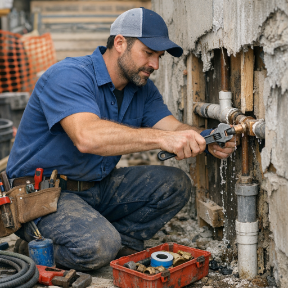
So, You Want to Be a Plumber?
Your Guide to Starting and Succeeding in the Plumbing Field
Plumbing might not be the first career that comes to mind in high school, but it’s a hands-on, rewarding field with strong demand and good pay. Plumbers keep our homes, schools, and businesses running by ensuring clean water comes in and waste goes out. If you’re a middle or high school student (or a parent of one) curious about plumbing as a career, this guide will walk you through how to get started, how to advance, how much you can earn, and the different paths this trade can offer – all in a casual, friendly tone. Let’s dive in!
Getting Started: Education and Training
What do you need to become a plumber? The good news: you don’t need a four-year college degree. Most plumbers start with high school education and then jump into specialized training. Here’s how you can get started:
- Finish High School (or Get Your GED): A high school diploma is typically the baseline. Pay attention to classes like math (you’ll use basic algebra and geometry for measurements) and any shop or technical education classes if your school offers them. Science courses (like physics) can help too, since plumbing involves water pressure and flow.
- Vocational Programs (Optional): Some high schools or community colleges have plumbing or construction trade programs. These programs teach you the basics of pipe systems, tool use, and safety. While optional, they can give you a head start and look great on an apprenticeship application.
- Apprenticeship – “Earn While You Learn”: This is the most common path into plumbing. An apprenticeship is like a training program where you work under experienced plumbers (and get paid) while also taking some classroom instruction. You’re basically learning on the job.
- How to get an apprenticeship: Usually, you apply through local plumbing companies, trade unions (like the United Association for plumbers/pipefitters), or contractor associations. Apprenticeships typically last about 4 to 5 years. Don’t let the length scare you – remember, you’re earning money the whole time and building real skills.
- What you’ll learn: During an apprenticeship, you’ll learn how to read blueprints, install and repair pipes, handle different materials (like copper, PVC, or steel pipes), and follow building codes and safety regulations. You’ll likely split your time between job sites (for hands-on experience) and classroom or shop time (for theory and fundamentals).
- Licensing and Certifications: Plumbing is a licensed trade in most U.S. states, which means after training you must pass a state or local exam to prove you know your stuff. The first big license is often the journeyman plumber license (more on “journeyman” in a bit). To get this, you usually need to complete your apprenticeship and pass an exam on plumbing codes and practices. Some states or cities might have a specific age requirement (often 18+) and a required number of hours of work training (usually a few thousand hours during your apprenticeship) before you can take the exam.
- Extra certifications: Beyond the basic license, plumbers can earn additional certifications for specific skills – for example, certifications in backflow prevention (to ensure water supply isn’t contaminated) or in medical gas piping for hospitals. These can come later but are worth mentioning as future goals.
Tip: Start talking to local plumbers or career counselors while you’re still in school. They can help you find apprenticeship opportunities or plumbing programs nearby. Some plumbing companies even offer pre-apprenticeship programs or summer jobs that let you taste the work before committing.
Climbing the Ladder: Apprentice, Journeyman, Master
Plumbing has a clear career ladder with milestone titles you’ll earn as you gain experience and expertise. Here’s the typical progression:
- Apprentice Plumber: This is where everyone starts. As an apprentice, you are learning by doing. You’ll work with skilled plumbers on real jobs – one day you might be helping rough-in pipes for a new house, another day you might assist in fixing a broken water heater. Expect to do a mix of tasks: from digging trenches for outdoor lines to fetching specialized tools, and gradually taking on more complex jobs as your skills grow. Apprenticeships usually last a few years. During that time, your responsibility and independence on the job increase. By the later years, you might be doing almost all the work of a full plumber, just with someone available to guide you when needed.
- Journeyman Plumber: Congratulations – after completing your apprenticeship and passing the licensing exam, you become a journeyman (sometimes just called a licensed plumber). Journeymen are fully qualified to work on their own. That means you can handle most installations and repairs without direct supervision. Journeymen plumbers in the U.S. work on all sorts of projects: installing plumbing in new buildings, troubleshooting plumbing issues in homes and commercial sites, and more. At this stage, you’ve proven your expertise in standard plumbing techniques and codes. Many plumbers spend the bulk of their careers as journeymen – it’s a solid position with high skill. You might work for a company, a contractor, or even for a city/town utility department. Some journeymen eventually start doing side jobs on their own or start building a client base, though in many places you’ll need the next level license to formally open your own shop.
- Master Plumber: This is the top tier of the trade. A master plumber usually has several years of journeyman experience and passes a master-level exam (which can be quite comprehensive, testing advanced knowledge of plumbing systems, design, and codes). Master plumbers are the veterans who can take on the most complex jobs. They often supervise other plumbers. For example, a master might be a job foreman running a big commercial plumbing project, or the person who designs a complex piping system for a new building. In many states, only a master plumber (or a plumbing contractor who usually is required to employ a master plumber) can pull certain permits or start a plumbing business. Essentially, becoming a master is often necessary if you dream of starting your own plumbing company or working as an independent contractor.
- Beyond Master? Master is as high as the official ladder goes in terms of skill qualification. But from master plumber, you can branch into roles like plumbing inspector (working for a city or county to inspect new installations for code compliance), project manager or estimator for a construction company, or even teaching plumbing at a trade school. Some master plumbers eventually become business owners who hire teams of plumbers – at that point you’re also wearing the hat of a small business owner, which has its own learning curve (managing budgets, customers, etc.).
Each step on this ladder comes with more independence, responsibility, and usually higher pay. It’s a tried-and-true path: Apprentice → Journeyman → Master is the journey from newbie to seasoned pro.
Show Me the Money: Earnings at Each Stage
Let’s talk dollars. One of the great things about plumbing careers is that you start earning money early (during the apprenticeship) and your earning potential grows as you advance. Here’s a breakdown of what you can expect in the U.S. (keep in mind actual wages vary by region, employer, and the economy – urban areas or union jobs might pay more than small towns, for example):
- Apprentice Pay: As an apprentice, you won’t make top dollar yet, but you will get paid while you train. Many apprenticeships start you at around 50% of a full plumber’s wage. For example, if licensed plumbers in your area make about $25 an hour, you might start around $12–$15 an hour as a first-year apprentice. That might translate to roughly $25,000–$35,000 per year to start. Not bad for a teenager just out of high school learning a trade! And here’s the best part: most apprentices get regular raises as they hit milestones in training. It’s common to get a bump each year of the apprenticeship. By your final year, you might be earning, say, 70% or more of a journeyman’s wage. So in your 4th or 5th year of training, you could be making around $18–$20 an hour, which could be about $40k a year. Plus, some programs include benefits like health insurance or small bonuses for completing school coursework.
- Journeyman Pay: Once you become a licensed journeyman plumber, your pay jumps significantly because now you’re fully productive for your employer or clients. According to recent data from the U.S. Bureau of Labor Statistics, the median pay for plumbers (which generally corresponds to journeyman level and above) is around $60,000 per year. In hourly terms, that’s roughly $28–$30 per hour as a median nationwide. Keep in mind this is an average — entry-level journeymen might start a bit lower, while experienced journeymen in strong markets earn more. In many cities, it’s not unusual for a journeyman plumber to earn $60,000–$70,000 annually after a few years of experience (that could be $30–$35 per hour). Overtime can boost these numbers further – plumbers often have opportunities to take emergency calls or extra hours for additional pay.
- Master Plumber and Beyond – Top Earnings: Master plumbers, due to their experience and often leadership roles, tend to be at the higher end of the pay scale. A master plumber working for a company might earn in the range of $70,000 to $90,000 a year. Masters who specialize (for instance, in complex industrial plumbing or high-end residential systems) or those who take on supervisory roles can earn even more. If you become a business owner (plumbing contractor), your earnings could go well into six figures — however, note that as an owner you have business expenses to manage too. It’s not a guaranteed bump, but many master plumbers do very well financially, especially if they build a good reputation. Top professionals in the field (for example, a master plumber who has a crew of plumbers working for them) might earn $100,000 or more per year once the business is established.
Important: These figures are general estimates. Plumbing wages can vary a lot. Unionized plumbers often have set wage scales (an apprentice might start at 50% of journeyman wage as mentioned, and a journeyman’s wage might be well-defined in a union contract). In some big cities, a union journeyman plumber can earn over $45 an hour (which would be about $90k/year). Meanwhile, in a smaller town, a non-union plumber working for a small company might earn somewhat less than the national median. The bottom line: as you gain skills, plumbing provides a comfortable income, and you won’t have the student debt that many college grads have. You’ll be earning from day one of your training.
For parents reading this: it’s okay if these numbers sound high or low compared to what you know — trades salaries can be hard to pin down because of regional differences. What’s consistent is the earning trajectory: entry-level pay during training, solid middle-class pay at the journeyman level, and potential for higher income with experience or business ownership.
Different Paths Within the Plumbing Field
One size doesn’t fit all in plumbing. Once you have your training and license, you can choose to specialize or work in different areas of plumbing based on what interests you. Here are some of the main paths within the plumbing field:
- 🏠 Residential Plumber: These plumbers work on homes and small businesses. If you’ve ever had a sink clog or a water heater go out, you know the value of a good residential plumber. They do things like repair leaks, install water heaters, replace faucets and toilets, and remodel bathrooms/kitchens. Residential plumbing can be like being a detective – you’re often troubleshooting issues in someone’s home. It’s a good path if you enjoy helping people directly and don’t mind working in different locations every day (you might drive a company truck from house to house). Many residential plumbers work for small businesses or even eventually start their own plumbing business serving a local area. One thing to note: residential plumbers often have an on-call rotation for emergencies (burst pipe at 2am, anyone?), but those emergency fees can add up to extra income.
- 🏢 Commercial Plumber: Commercial plumbers focus on larger projects, like schools, hospitals, office buildings, or factories. The work can involve big, complex plumbing systems. For example, installing miles of pipe in a new multi-story building, or maintaining the boiler and chiller systems in a hospital. The jobs often come on a larger scale and you might be part of a big crew of plumbers on a construction site. Commercial plumbing work is typically steadier hours (often daytime if it’s new construction or scheduled maintenance) and can be less about surprise emergency fixes and more about planned work. It can be really satisfying to walk by a huge building and know “I helped build that’s plumbing!” If you like working with a team and tackling big challenges, commercial plumbing is a great path. Commercial plumbers are often union-affiliated (depending on the region) and might overlap with the pipefitting trade (below).
- 🔧 Pipefitting/Steamfitting (Industrial Plumbing): You’ll hear the term “pipefitter” often paired with plumbers. Pipefitters and steamfitters typically work on industrial projects – think factories, power plants, or shipyards. They install and repair pipes that carry high-pressure substances like steam, chemicals, or gases (not just water). This path might require learning specialized welding techniques and working with heavy-duty metals. It’s still plumbing, but a very specialized branch. Many training programs for plumbers actually cover pipefitting as well (the trade is often collectively referred to as “Plumbers, Pipefitters, and Steamfitters”). If you’re interested in high-tech systems or industrial processes, this could be your niche. Pipefitters often have strong earning potential too, given the specialized skills involved.
- **🌡️ HVAC and Sprinkler Systems: Some plumbers diversify into related fields like HVAC (Heating, Ventilation, and Air Conditioning) or fire protection. For instance, some plumbers install sprinkler systems in buildings (these are the fire sprinklers in ceilings). While sprinkler fitting or HVAC tech are technically separate trades, there’s overlap – a lot of plumbers pick up these skills or work for companies that handle all aspects of building mechanical systems. Being multi-skilled can make you even more employable.
- 🕵️ Plumbing Inspector: Every city and county needs inspectors to make sure plumbing work meets code and is safe. After years in the field, a plumber can take a position as an inspection officer for a municipality or building department. In this role, you’re not doing the installation work; you’re checking others’ work and signing off that it’s done right. It’s a shift from hands-on labor to a regulatory role, often with stable hours (and benefits of a government job). It usually requires that master plumber license and deep knowledge of plumbing codes. If you think down the road you’d prefer a more desk-and-field-mix job (some paperwork, some site visits) with no heavy lifting, inspection is a path to consider.
- 💼 Business Owner (Plumbing Contractor): Finally, many experienced plumbers choose to be their own boss. As mentioned earlier, with a master license you can often start your own plumbing business. This means you might hire your own team of plumbers (often starting with you and maybe one helper, then growing). As an owner, you’ll be doing a mix of actual plumbing work and business tasks – finding customers, giving price estimates, managing jobs, and handling finances. It’s a challenging path but can be very rewarding both personally and financially if you succeed. Parents of entrepreneurial-minded students might find this aspect appealing: a skilled trade like plumbing can turn into running a successful small business.
No matter which path you choose, the core plumbing skills you learn as an apprentice and journeyman will apply. The field is flexible – you might start in residential, and later move into commercial work, or vice versa. You might work for a company for 10 years, then decide to launch your own garage-based plumbing service. Plumbing also offers portability: with the right licenses, you can work in different cities or states (though you may need to test for a new license if you move states).
A Few Final Thoughts
Plumbing is more than just fixing toilets (though you’ll do that too!). It’s about problem solving, physical work, and making a tangible difference every day. Not everyone is cut out to sit at a desk all day – if you like working with your hands, being active, and you take pride in seeing a job well done (like “I installed that sink and it works perfectly!”), plumbing can be a fantastic career. It’s also a career that can start right after high school, with a clear path to advancement and without the burden of college debt.
For students, the idea of jumping into the workforce so soon can be exciting – you’ll gain independence quickly. For parents, knowing that your child can enter a stable trade, with a strong income potential and career growth, offers peace of mind. Plumbers literally protect the health of the nation (there’s a saying that “the plumber protects the health of the populace” because clean water and sanitation are so vital). It’s a respected profession, and skilled plumbers are always in demand across the U.S.
Is plumbing right for you? If the idea of learning a useful skill, having job security, and eventually earning a comfortable living (or even running your own business) appeals to you, it’s worth considering. Maybe you like tinkering with tools, or you helped a family member fix a sink and found it interesting — those are good signs. On the flip side, if you really dislike getting dirty or working in tight spaces, you should know that comes with the job too! But many plumbers will tell you the trade has a special camaraderie and satisfaction that’s hard to beat.
Next steps: Talk to your school’s career counselor about local apprenticeship programs, reach out to plumbing companies or unions in your area, and see if you can shadow a plumber for a day. You might be surprised at how much you enjoy it. With determination and the right training, in just a few years you could be a licensed plumber with a world of opportunities ahead.
Plumbing might start with a wrench and some pipes, but it can grow into a lifelong, prosperous career. College is great for some, but the trades are great for others – it all depends on you. Good luck on whatever path you choose!
